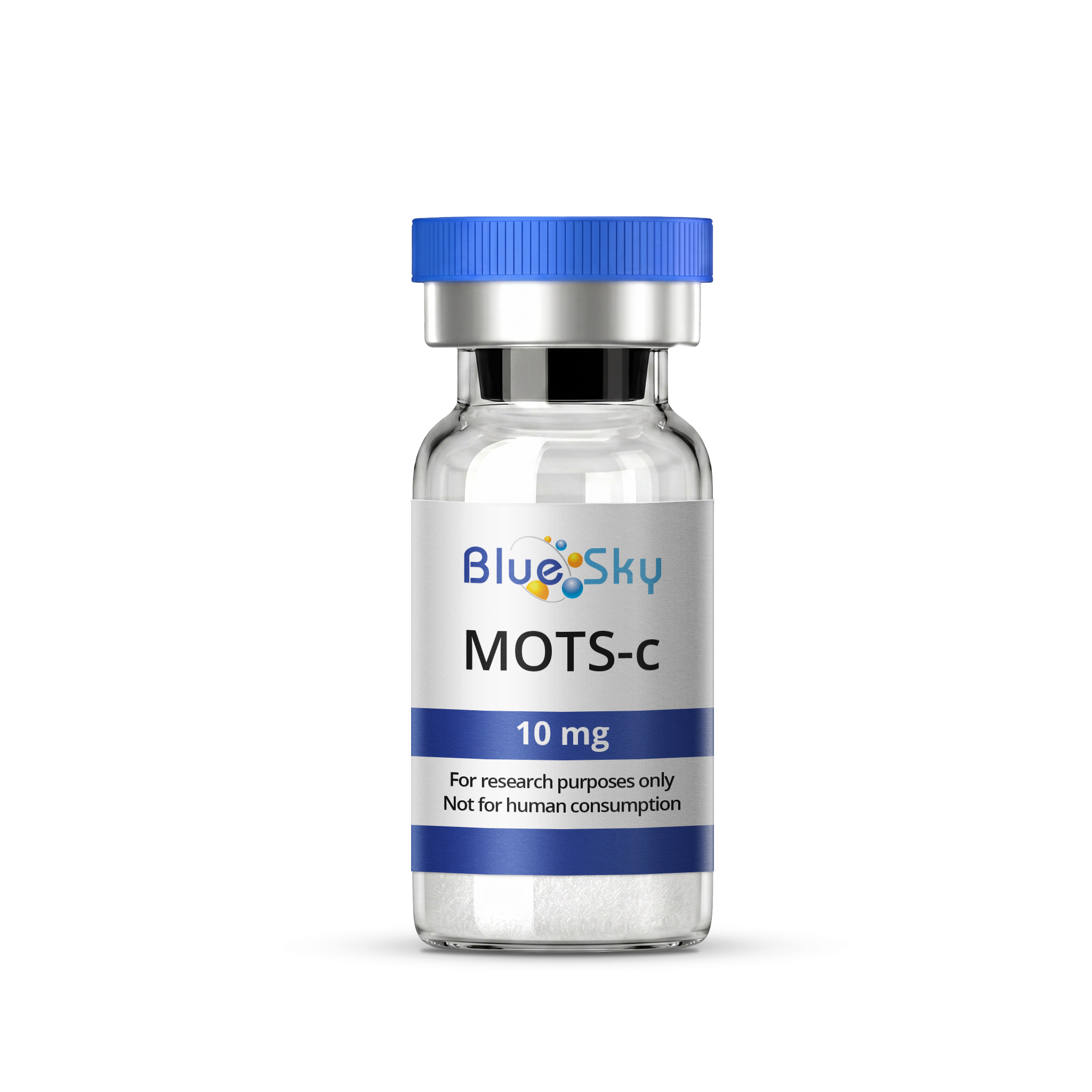
MOTS-c 10mg

- Free Priority Shipping
- Orders over $75



MOTS-c 10mg :
| Unit Size | 10 mg/vial |
| Unit Quantity | 1 vial |
| Purity (Mass Spectrometry and UV) | 99.61% |
| Sequence | Met-Arg-Trp-Gln-Glu-Met-Gly-Tyr-Ile-Phe-Tyr-Pro-Arg-Lys-Leu-Arg |
| Molecular Formula | C101H152N28O22S2 |
| Appearance | Lyophilized White Powder |
| Source | Chemical Synthesis |
| Storage | Lyophilized MOTS-c 10mg is stable at room temperature for 90 days, however it is best to store in a freezer at -20°C for any extended period of time. |
| Terms | The products we offer are intended for laboratory research use only. Please familiarize yourself with our terms of service prior to ordering. |
| COA Verification | Verify this COA on MZ Biolabs → |
MOTS-c 10mg
View Research Overview & References
MOTS-c—short for Mitochondrial ORF of the 12S rRNA Type C—is a 16-amino acid peptide originating from the mitochondrial genome's 12S rRNA region. As part of the class of mitochondrial-derived peptides (MDPs), it is studied in vitro for its role in cellular stress-response signaling.
Nuclear Translocation Research in Cells
In vitro studies using cells found that MOTS-c dynamically translocates from the cytoplasm to the nucleus in response to metabolic stress, where it regulates nuclear gene expression in an AMPK-dependent manner.
Substituting the hydrophobic core residues of MOTS-c with alanines prevented this nuclear translocation, indicating that the process depends on the peptide's specific sequence rather than concentration alone.1
Peptide Origin: A Mitochondrially-Encoded Research Peptide
MOTS-c is structurally unusual among research peptides in that its sequence is encoded within a short open reading frame inside the mitochondrial 12S ribosomal RNA gene rather than by a conventional nuclear protein-coding gene.
Researchers studying its biology have noted that this mitochondrial origin required the discovery of an unconventional translation event, since the 12S rRNA region was not previously recognized as protein-coding. This distinguishes MOTS-c from the broader category of nuclear-DNA-derived signaling peptides.
Analytical Purity Verification
Purity verification for MOTS-c typically combines HPLC with mass spectrometry to confirm the intact 16-residue sequence, with particular attention to the two methionine residues present in the sequence, which are susceptible to oxidation during synthesis and storage.
Storage and Handling in the Laboratory Setting
Given the oxidation-prone methionine residues in its sequence, MOTS-c is best preserved in lyophilized form under sub-zero freezer conditions, away from light and oxidative exposure, since methionine oxidation could alter the peptide's structural and signaling properties in downstream cell-based assays.
Comparative Research Context Among Mitochondrial-Derived Peptides
MOTS-c is studied alongside other mitochondrial-derived peptides, including humanin and the small humanin-like peptides (SHLPs), all of which originate from short open reading frames within mitochondrial DNA rather than the nuclear genome.
Researchers comparing these peptides have focused on their distinct tissue distributions and signaling targets, using MOTS-c's documented AMPK-pathway activation and nuclear translocation under metabolic stress as a point of contrast with humanin's separately characterized cytoprotective signaling profile.
What an Open Reading Frame Is
The ORF in this peptide's name stands for open reading frame, a stretch of genetic sequence that begins with a start codon, runs in groups of three bases without interruption, and ends at a stop codon. Any such stretch is, in principle, translatable into a chain of amino acids.
Part of why the 12S rRNA region went unexamined for so long is that mitochondria do not use the same genetic code as the rest of the cell. Several codons are read differently there, so a sequence scanned with the standard code can appear to terminate where the mitochondrial code would continue, concealing short reading frames like this one.
Methionine Oxidation and Its Mass Signature
The two methionine residues sit at positions 1 and 6. Methionine contains a sulfur atom in a thioether arrangement that readily picks up a single oxygen to form a sulfoxide, the most common modification seen in peptides of this composition.
Each oxidation event adds approximately 16 Da. Because there are two methionines, mass spectrometry on a degraded sample may show species at both 16 and 32 Da above the parent mass, corresponding to one or both residues oxidized. Reviewing a spectrum for those two satellite peaks is a direct way to assess whether stored material has begun to change.
A Basic, Aromatic-Rich Composition
MOTS-c carries an unusually high proportion of both charged and aromatic residues for its length:
- Basic: three arginines, at positions 2, 13, and 16, plus one lysine at position 14
- Acidic: a single glutamate at position 5
- Aromatic: one tryptophan, two tyrosines, and one phenylalanine
Four basic residues against one acidic leaves a pronounced net positive charge near neutral pH. The tryptophan and tyrosine content also gives this peptide a strong absorbance at 280 nm, so unlike peptides lacking those residues it can be monitored at that wavelength as well as at 214 nm.
Alternate Names in the Literature
This peptide appears in published work and supplier catalogs as MOTS-c, MOTSc, MOTS-c Peptide, and the expanded form Mitochondrial Open Reading Frame of the 12S rRNA Type-c. Each refers to the same 16-residue sequence shown in the specification table above.
Important Compliance Notice
This product is intended strictly for in vitro laboratory research. It is not for human consumption, nor is it approved for diagnostic or therapeutic applications. These findings do not establish safety, efficacy, or suitability for any human application.
References
1. Kim KH, Son JM, Benayoun BA, Lee C. The mitochondrial-encoded peptide MOTS-c translocates to the nucleus to regulate nuclear gene expression in response to metabolic stress. Cell Metab. 2018;28(3):516-524.e7.
 SS-31 10mg$58.47
 NAD+ 500mg$91.62
 5-AMINO-1MQ 10mg$32.47
 AOD-9604 2mg$35.72
 Storage Case (10)$9.99


 Login