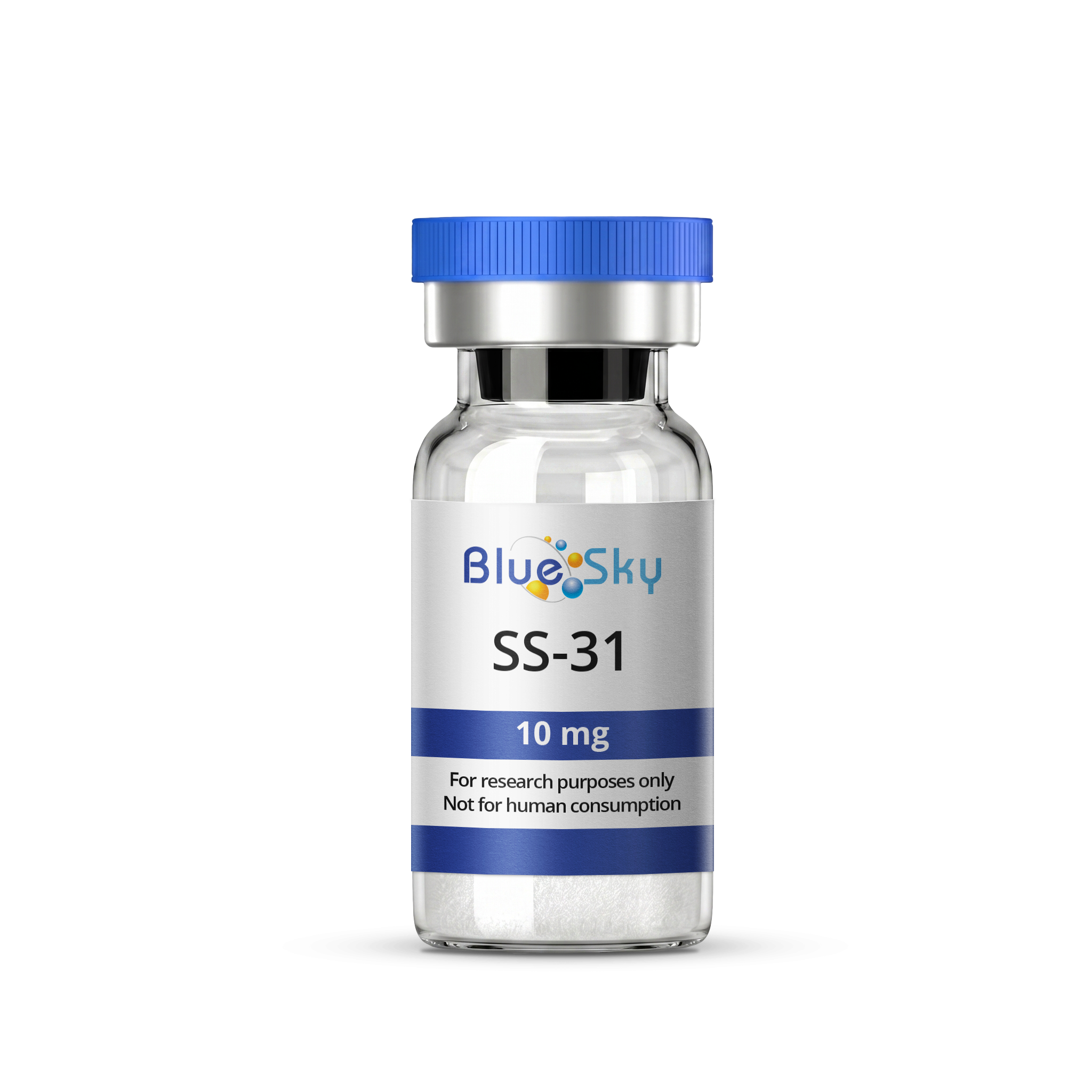
SS-31 10mg

- Free Priority Shipping
- Orders over $75



Buy SS-31 10MG Peptide:
| Unit Size | 10 mg/ vial |
| Unit Quantity | 1 vial |
| Purity (Mass Spectrometry and UV) | 99.81% |
| Sequence | D-Arg–Dmt–Lys–Phe-NH2 |
| Molecular Formula | C32H49N9O5 |
| Appearance | Lyophilized White Powder |
| Source | Chemical Synthesis |
| Storage | Lyophilized SS-31 is stable at room Temperature for 90 days, however it is best to store in a freezer below - 8c for any extended period of time. |
| Terms | The products we offer are intended for laboratory research use only. Please familiarize yourself with our terms of service prior to ordering. |
SS-31 10mg
View Research Overview & References
SS-31 Peptide, also known in the scientific literature as a mitochondria-targeting tetrapeptide, is composed of the amino acid sequence D-Arg–Dmt–Lys–Phe. SS-31 has been examined in in vitro laboratory research for its interaction with mitochondrial membranes and its role in cellular oxidative stress pathways.
This product is intended exclusively for in vitro laboratory research applications and is not intended for human or veterinary use.
Mitochondrial Antioxidant Mechanism Research
In vitro studies using isolated mitochondria and N2A cells, an established neuroblastoma cell line, found that SS-31 inhibits mitochondrial swelling and oxidative cell death induced by oxidative stressors such as t-butylhydroperoxide, and reduces mitochondrial reactive oxygen species production in this cell-based system.1
Cell-Based Neuroprotection Research
In vitro studies using established neuronal cell lines found that SS-31 prevents mitochondrial depolarization and apoptosis induced by oxidative stressors within these cultured cell systems.2
Peptide Structure: The Aromatic-Cationic Design Motif
SS-31 belongs to a family of synthetic peptides characterized by alternating aromatic and cationic residues, a design that researchers have linked to the compound's ability to cross the plasma membrane in an energy-independent manner despite carrying a net positive charge of +3 at physiological pH.
The Dmt (2,6-dimethyltyrosine) residue, a non-natural amino acid, is of particular research interest for its role in cardiolipin binding, while the D-configuration at the arginine position is understood to confer resistance to standard proteolytic degradation, since most peptidases are specific for L-amino acid substrates.
Analytical Purity Verification
Purity verification for SS-31 typically combines HPLC and mass spectrometry to confirm the correct 4-residue sequence, the presence of the non-standard Dmt residue, and the C-terminal amide modification.
Researchers reviewing a certificate of analysis are encouraged to confirm that analytical data accounts for the Dmt residue specifically, since it is structurally distinct from standard tyrosine and could be misidentified by methods calibrated only for conventional amino acids.
Storage and Handling in the Laboratory Setting
Lyophilized SS-31 is stored under sub-zero freezer conditions to preserve integrity between experimental sessions, consistent with standard handling practices for short synthetic research peptides used in mitochondrial and cell-based assay work.
Comparative Research Context Among Szeto-Schiller Peptides
SS-31 is studied alongside other members of the Szeto-Schiller peptide family, including SS-20, which shares the same alternating aromatic-cationic design but differs in sequence order and lacks the Dmt-specific cardiolipin-binding activity attributed to SS-31.
Researchers comparing these family members have used differences in their cardiolipin-binding affinity and downstream mitochondrial effects in cell-based systems to isolate which structural features of SS-31 are responsible for its studied activity.
Important Notice
This SS-31 peptide product is strictly for in vitro laboratory research only and is not approved for human use. Any application outside of controlled in vitro laboratory research settings is prohibited. Results obtained from laboratory research do not establish safety, efficacy, or suitability for clinical, diagnostic, or therapeutic use.
Product Information
SS-31 is supplied for research purposes only. It should be handled by qualified laboratory personnel and used in accordance with standard laboratory safety procedures. This material is intended solely for controlled laboratory experimental applications.
References
1. Zhao K, Zhao GM, Wu D, Soong Y, Birk AV, Schiller PW, Szeto HH. Cell-permeable peptide antioxidants targeted to inner mitochondrial membrane inhibit mitochondrial swelling, oxidative cell death, and reperfusion injury. J Biol Chem. 2004;279(33):34682–34690.
2. Zhao K, Luo G, Giannelli S, Szeto HH. Mitochondria-targeted peptide prevents mitochondrial depolarization and apoptosis induced by tert-butyl hydroperoxide in neuronal cell lines. Biochem Pharmacol. 2005;70(12):1796-1806.


 Login
Login