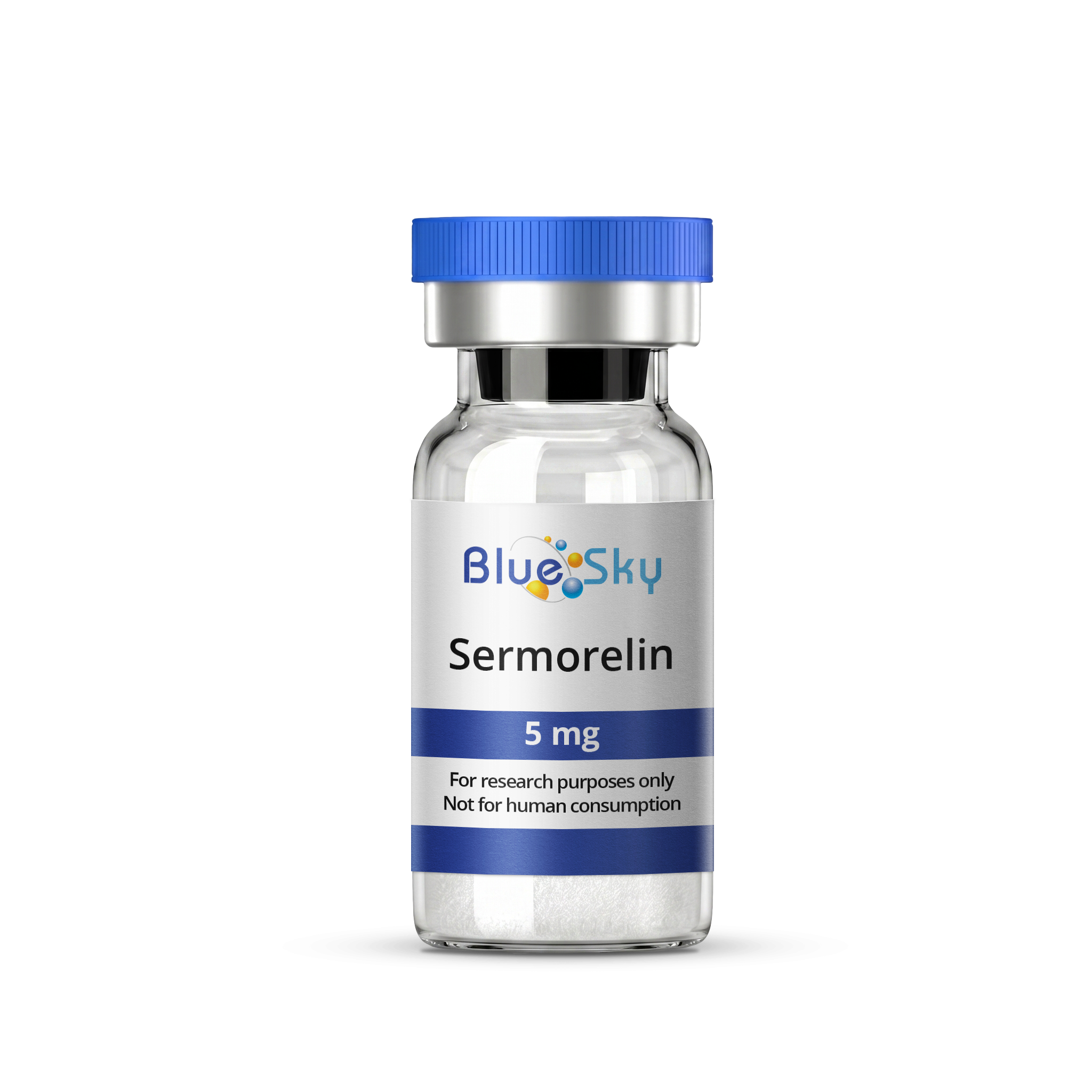
Sermorelin-5mg

- Free Priority Shipping
- Orders over $75


Buy Sermorelin 5mg :
| Unit Size | 5 mg/vial |
| Unit Quantity | 1 vial |
| Purity (Mass Spectrometry and UV) | 99.16% |
| Sequence | H-Tyr-Ala-Asp-Ala-Ile-Phe-Thr-Asn-Ser-Tyr-Arg-Lys-Val-Leu-Gly-Gln-Leu- Ser-Ala-Arg-Lys-Leu-Leu-Gln-Asp-Ile-Met-Ser-Arg-NH2 |
| Molecular Formula | C149H246N44O42S |
| Appearance | Lyophilized White Powder |
| Source | Chemical Synthesis |
| Storage | Lyophilized Sermorelin is stable at room temperature for 90 days; however, it is best stored in a freezer at -20°C for any extended period of time. After reconstitution, Sermorelin should be refrigerated at temperatures not to exceed 35°F. |
| Terms | The products we offer are intended for laboratory research use only. Please familiarize yourself with our terms of service prior to ordering. |
Sermorelin 5mg
View Research Overview
Sermorelin, also referred to in the literature as GHRH(1–29)-NH2 or GRF(1–29) amide, is a truncated synthetic form of growth hormone-releasing hormone. It retains the first 29 of the native peptide's 44 residues.
Researchers use it in vitro to probe ligand recognition and signaling at the GHRH receptor.
Sequence Relationship to Native GHRH
Removing residues 30–44 shortens the peptide by roughly a third without removing the receptor-activating region. This makes the 1–29 fragment easier to synthesize and purify to high purity than the full-length sequence.
The N-terminal end is the functionally critical portion. Structural work on the receptor shows the N-terminus of GHRH reaching deep into the receptor core, where it forms an extensive network of specific contacts [1].
The rest of the 1–29 sequence forms an amphipathic helix in the bound state, with one face rich in hydrophobic residues such as Ile, Leu and Val, and the other carrying charged Arg, Lys and Asp side chains.
Charge and Solubility Profile
Sermorelin carries five basic residues (Arg11, Lys12, Arg20, Lys21, Arg29) plus a free N-terminal amine, against two acidic residues (Asp3, Asp25). Its C-terminus is amidated and uncharged.
The result is a net positive charge of about +4 at neutral pH. In practical terms, this means:
- Good solubility in water or dilute acidic solutions
- A tendency to adsorb onto glass and some plastic surfaces
- Possible loss of material at low concentrations unless low-binding labware or a carrier protein is used
Surface adsorption is easy to overlook. It can quietly reduce the effective concentration in dilute working solutions and shift concentration–response curves.
Receptor Family Context
The GHRH receptor belongs to the secretin-like (class B1) GPCR family, alongside receptors for peptides such as vasoactive intestinal peptide (VIP) and secretin. These receptors share a large extracellular domain and similar overall architecture.
That family resemblance has been used experimentally. Chimeric receptors combining parts of the GHRH, VIP and secretin receptors, expressed in cultured cells, showed that the N-terminal domain is required for GHRH binding, while the transmembrane region and extracellular loops carry much of the binding specificity [2].
The same work measured cAMP accumulation as the functional readout, reflecting the receptor's coupling to Gαs and adenylyl cyclase [2].
Considerations for In Vitro Assay Design
Common elements in sermorelin-based receptor assays include:
- Cell system: receptor-transfected cell lines, with the untransfected parental line as a negative control
- Readout: cAMP accumulation or a cAMP-responsive reporter
- Media: serum-free conditions where possible, since serum contains dipeptidyl peptidase IV (DPP-IV), which can remove the N-terminal Tyr-Ala dipeptide
- Concentration series: freshly diluted from a verified stock to limit adsorption and degradation
Sermorelin as a Parent Sequence for Analog Design
Because its weak points are well mapped, the 1–29 sequence has served as a starting template in peptide design research. Each known liability corresponds to a residue that can be substituted:
- Ala2: part of the DPP-IV recognition site; replacement with a D-amino acid is a common strategy to block N-terminal cleavage
- Asn8: prone to deamidation; replacement with residues such as Gln or Ser reduces rearrangement
- Met27: the oxidation site; replacement with Leu or norleucine removes it
- Gly15: a helix-weakening residue; replacement with Ala is used to favor helical structure
Unmodified sermorelin therefore often serves as the baseline comparator when the stability or receptor activity of these modified sequences is evaluated in vitro.
Concentration Determination by UV
Sermorelin contains two tyrosines and no tryptophan, so its absorbance at 280 nm is relatively weak. Using a standard tyrosine extinction coefficient of about 1,490 M−1cm−1 per residue, a 1 mg/mL solution gives an expected A280 of roughly 0.9 in a 1 cm path.
This provides a quick cross-check on stock concentration, which is especially useful given the counterion and water content discussed below.
Purity Versus Peptide Content
HPLC purity and net peptide content are different measurements. Purity describes the proportion of the target peptide relative to peptide-related impurities. Net peptide content describes how much of the lyophilized powder’s weight is peptide.
The remainder of the powder weight is mainly counterions, such as acetate bound to the basic residues, and residual water. For a peptide with several Arg and Lys residues, counterions can make up a meaningful share of the total weight.
For quantitative work, laboratories often account for net peptide content when preparing stock solutions, rather than assuming the vial weight is entirely peptide.
Lot Consistency Across Experiments
Experiments that run over several sessions benefit from drawing on a single synthesis lot. This removes lot-to-lot variation in impurity profile and peptide content as a source of experimental noise.
Good practice includes recording the lot number for each experiment, matching it to the certificate of analysis, and preparing single-use aliquots from one reconstituted stock.
Analytical attention for this sequence typically focuses on Met27 oxidation, Asp3 and Asn8 rearrangement products, and truncated sequences from synthesis [3].
References
- Zhou F, Zhang H, Cong Z, et al. Structural basis for activation of the growth hormone-releasing hormone receptor. Nat Commun. 2020;11:5205. doi:10.1038/s41467-020-18945-0
- DeAlmeida VI, Mayo KE. Identification of binding domains of the growth hormone-releasing hormone receptor by analysis of mutant and chimeric receptor proteins. Mol Endocrinol. 1998;12(5):750–765.
- Bongers J, Heimer EP, Lambros T, Pan YCE, Campbell RM, Felix AM. Degradation of aspartic acid and asparagine residues in human growth hormone-releasing factor. Int J Pept Protein Res. 1992;39:364–374.
Important Notice
Sermorelin is provided exclusively for laboratory research purposes (in vitro). This peptide is not intended for human consumption or use, and any application outside of controlled laboratory research is prohibited. These findings do not establish safety, efficacy, or suitability for any human application, and have not been evaluated by the FDA or any regulatory agency.
Product Information
Sermorelin is supplied as a lyophilized powder for laboratory research use only.


 Login