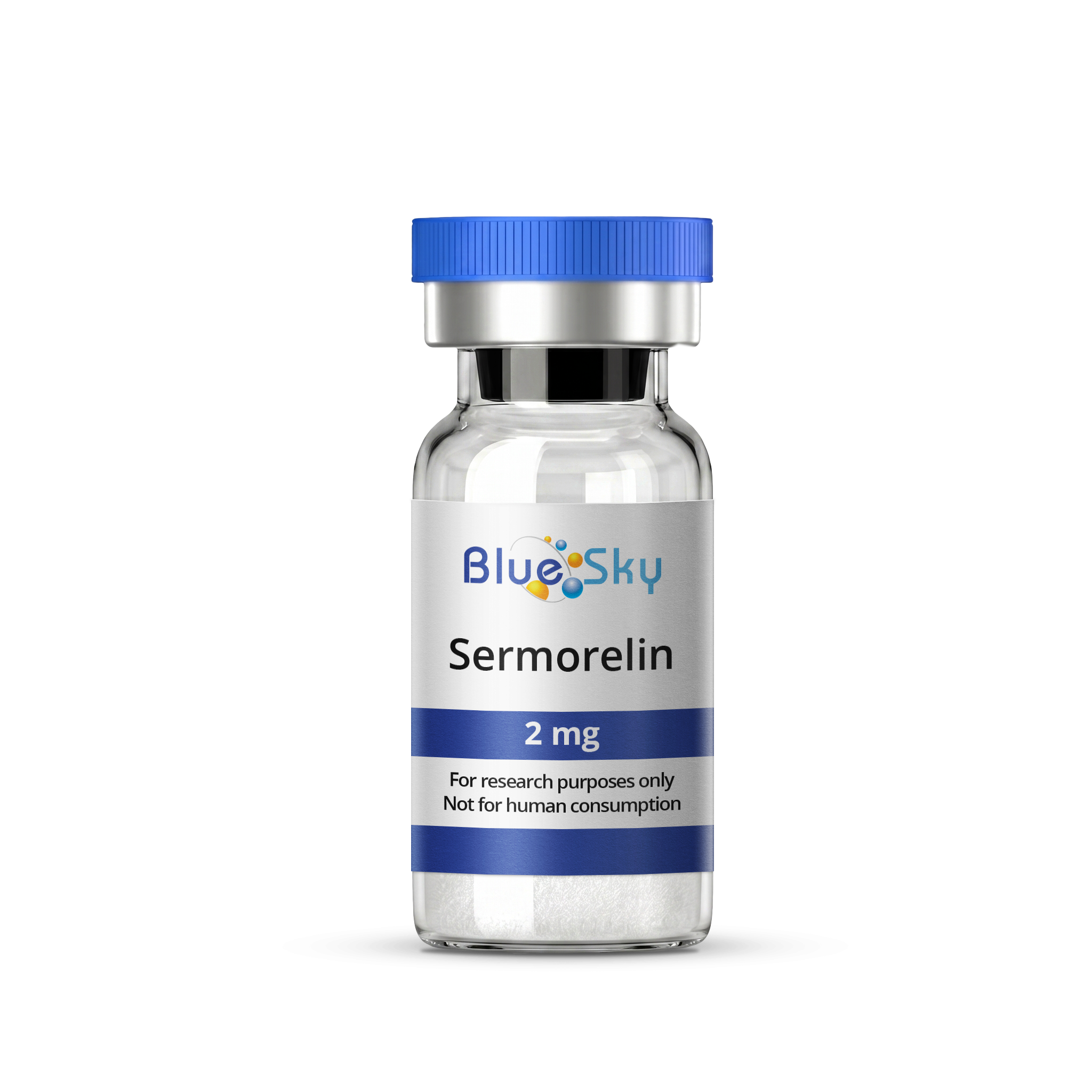
Buy Bulk Sermorelin 2mg
- Buy 50 for $15.95 each and save 69%
- Buy 100 for $14.95 each and save 71%
- Buy 200 for $13.95 each and save 73%

- Free Priority Shipping
- Orders over $75


Buy Bulk Sermorelin 2mg (No Promo Codes):
| Unit Size | 2 mg/vial |
| Unit Quantity | 1 vial |
| Purity (Mass Spectrometry and UV) | 99.16% |
| Sequence | H-Tyr-Ala-Asp-Ala-Ile-Phe-Thr-Asn-Ser-Tyr-Arg-Lys-Val-Leu-Gly-Gln-Leu- Ser-Ala-Arg-Lys-Leu-Leu-Gln-Asp-Ile-Met-Ser-Arg-NH2 |
| Molecular Formula | C149H246N44O42S |
| Appearance | Lyophilized White Powder |
| Source | Chemical Synthesis |
| Storage | Lyophilized Sermorelin is stable at room temperature for 90 days; however, it is best stored in a freezer at -20°C for any extended period of time. After reconstitution, Sermorelin should be refrigerated at temperatures not to exceed 35°F. |
| Terms | The products we offer are intended for laboratory research use only. Please familiarize yourself with our terms of service prior to ordering. |
Bulk Sermorelin 2mg
View Research Overview
This listing supplies sermorelin in 2mg vials for laboratories that need multiple units of the same peptide. Sermorelin is the amidated 1–29 fragment of growth hormone-releasing hormone, a 29-residue linear peptide with no disulfide bonds or non-standard amino acids.
Its in vitro research uses center on GHRH receptor binding and cAMP signaling, peptide secondary structure, and the analytical chemistry of medium-length synthetic peptides.
How a 29-Residue Peptide Is Made
Sermorelin is produced by solid-phase peptide synthesis, in which amino acids are added one at a time to a growing chain anchored on a resin bead. A 29-residue sequence requires 28 consecutive coupling steps.
Small inefficiencies compound over that many steps. At 99% efficiency per coupling, only about 75% of chains would be full length before purification. At 99.5%, the figure rises to roughly 87%.
The remainder consists of closely related deletion sequences, each missing one residue. Because they differ only slightly from the target, preparative reversed-phase HPLC is used to separate them, and analytical HPLC confirms how well that worked.
Secondary Structure and Circular Dichroism
In dilute aqueous buffer, sermorelin is largely flexible. In helix-promoting conditions, such as solutions containing trifluoroethanol or membrane-mimetic micelles, it gains substantial α-helical character.
Circular dichroism (CD) spectroscopy is the standard way to measure this in vitro. An α-helical peptide shows characteristic negative bands near 208 nm and 222 nm, while a disordered peptide shows a single negative band near 200 nm.
Tracking the 222 nm signal across solvent conditions gives a simple, quantitative read on helix content. This is useful when comparing sermorelin with modified analogs.
Receptor Binding Assay Formats
Binding to the GHRH receptor is commonly measured with a radiolabeled GHRH probe on membranes from receptor-expressing cells. Two complementary formats are used [1]:
- Saturation binding: increasing concentrations of labeled ligand, giving the dissociation constant (Kd) and receptor density (Bmax)
- Competition binding: a fixed amount of labeled ligand displaced by increasing concentrations of unlabeled peptide, giving an IC50 that can be converted to an inhibition constant (Ki)
Functional activity is then measured separately, usually as cAMP accumulation, since binding affinity and signaling potency do not always track together [1].
At the structural level, the receptor engages its peptide ligand through both its extracellular domain and its transmembrane core, with the ligand's N-terminal residues making the most extensive contacts [2].
Reading a Mass Spectrum: Expected Values
For quality control, it helps to know where the target peptide and its common degradants should appear. Approximate monoisotopic masses:
- Intact sermorelin: about 3355.8 Da
- Met27 sulfoxide: +16 Da, about 3371.8 Da
- Deamidation at Asn8: +1 Da, about 3356.8 Da
- Asp3 isomerization: no mass change, detected by HPLC retention time [3]
- Loss of the N-terminal Tyr-Ala dipeptide: −234.1 Da, giving the 3–29 fragment at about 3121.7 Da
In electrospray mass spectrometry, these species usually appear as multiply charged ions, so observed m/z values must be deconvoluted to compare with the masses above.
Choosing a Stock Solvent
For in vitro work, sermorelin is commonly dissolved first in high-purity water or dilute acetic acid to make a concentrated stock, which is then diluted into assay buffer shortly before use.
A few practical points guide that choice:
- Concentrated stocks lose proportionally less peptide to container surfaces than dilute ones
- Slightly acidic conditions are generally preferred for holding stocks, since Asn deamidation tends to speed up as pH rises [3]
- If filtration is needed, low-protein-binding membranes help avoid peptide loss
- Carrier protein, when used, is best added at the final dilution step rather than to the stock
Net Peptide Content Versus Weight
The weight on a vial label is not all peptide. A lyophilized powder also contains counterions and residual water, and for a basic peptide like sermorelin, which carries five Arg and Lys residues, the acetate counterions alone can account for a meaningful share of the mass.
For quantitative work, the figure that matters is net peptide content: the fraction of the powder weight that is actually peptide, usually determined by amino acid analysis and reported on the certificate of analysis. Preparing a stock from the gross vial weight, rather than the net peptide weight, systematically overstates the true concentration.
A quick cross-check is available by UV. Sermorelin's two tyrosines absorb at 280 nm, so a measured absorbance can be compared against the value expected from the net peptide concentration, flagging gross pipetting or weighing errors before an assay is run.
Working With Multiple Vials
Ordering several vials at once gives a laboratory a uniform supply for repeated or extended studies. A few practices help preserve that consistency:
- Confirm all vials share one lot number and keep the matching certificate of analysis on file
- Keep unopened vials frozen and remove only what each experiment requires
- Reconstitute each vial the same way, using the same solvent, volume and labware
- Label working solutions with lot, date and concentration
- Record which vial was used in each experiment so any outlier result can be traced
Unopened lyophilized vials hold up far better than solutions, so staggering reconstitution across the study period avoids carrying aged solution forward.
Why Single-Lot Supply Reduces Variability
Drawing a whole study from one synthesis lot removes a hidden source of experimental noise. Different lots can differ slightly in impurity profile and net peptide content, and those small differences can shift a concentration–response curve enough to matter when results are compared across experiments.
With a single lot in hand, a laboratory can also characterize the material once, by HPLC and mass spectrometry, and apply that characterization to every experiment in the series rather than re-verifying each new lot. Good practice is to record the lot number against each experiment and to retain the certificate of analysis for the full study period.
References
- DeAlmeida VI, Mayo KE. Identification of binding domains of the growth hormone-releasing hormone receptor by analysis of mutant and chimeric receptor proteins. Mol Endocrinol. 1998;12(5):750–765.
- Zhou F, Zhang H, Cong Z, et al. Structural basis for activation of the growth hormone-releasing hormone receptor. Nat Commun. 2020;11:5205. doi:10.1038/s41467-020-18945-0
- Bongers J, Heimer EP, Lambros T, Pan YCE, Campbell RM, Felix AM. Degradation of aspartic acid and asparagine residues in human growth hormone-releasing factor. Int J Pept Protein Res. 1992;39:364–374.
Important Notice
Sermorelin is provided exclusively for laboratory research purposes (in vitro). This peptide is not intended for human consumption or use, and any application outside of controlled laboratory research is prohibited. These findings do not establish safety, efficacy, or suitability for any human application, and have not been evaluated by the FDA or any regulatory agency.
Product Information
Sermorelin is supplied as a lyophilized powder for laboratory research use only.


 Login