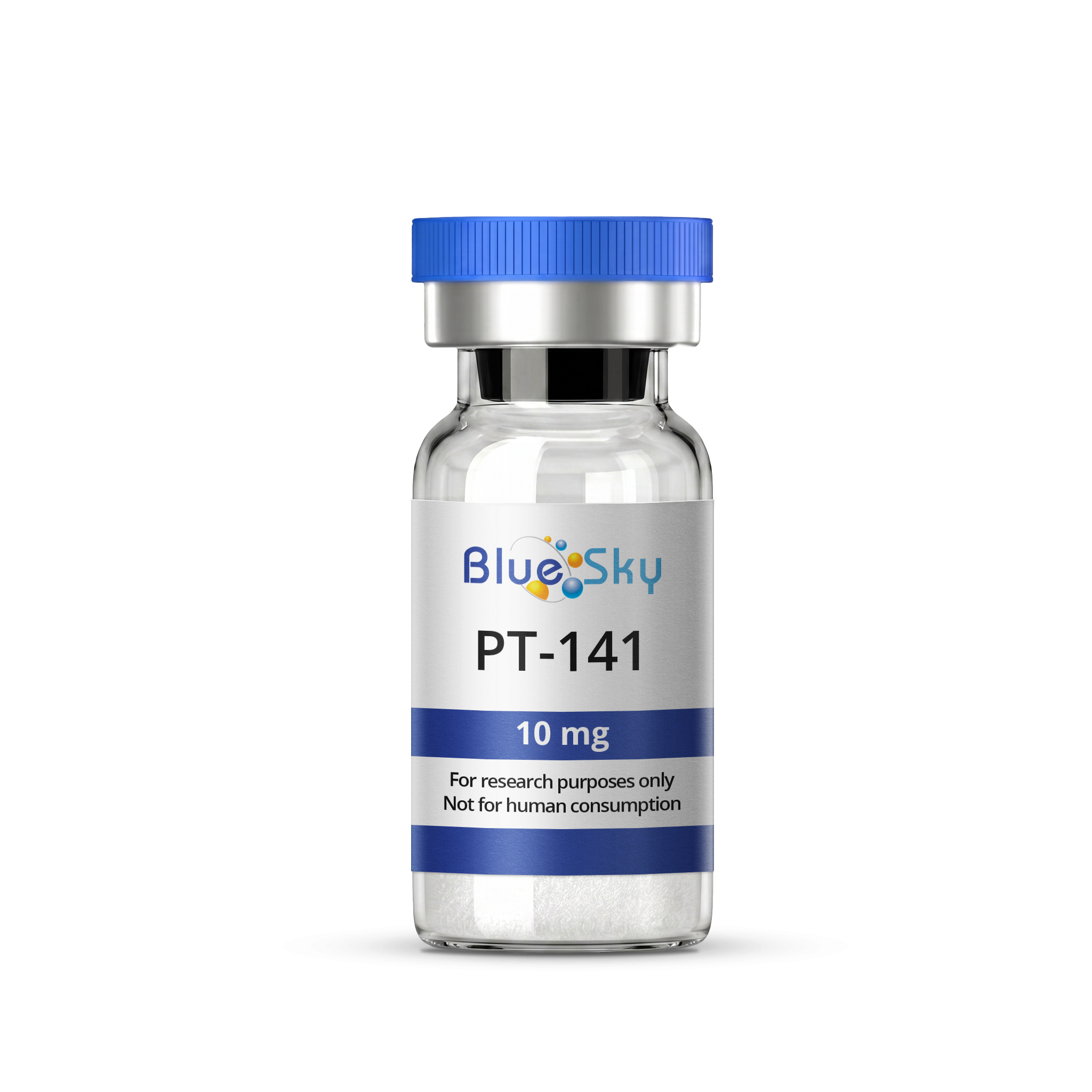
PT-141 (Bremelanotide) 10mg

- Free Priority Shipping
- Orders over $75



Buy PT-141 (Bremelanotide) 10 MG :
| Unit Size | 10 mg/vial |
| Unit Quantity | 1 vial |
| Purity (Mass Spectrometry and UV) | 99.63% |
| Sequence | Ac-Nle-cyclo[Asp-His-D-Phe-Arg-Trp-Lys]-OH |
| Molecular Formula | C50H68N14O10 |
| Appearance | Lyophilized White Powder |
| Source | Chemical Synthesis |
| Storage | Lyophilized PT-141 is stable at room temperature for 90 days, however it is best to store in a freezer below -8°C for any extended period of time. After reconstitution, PT-141 should be refrigerated at temperatures not to exceed 35°F. |
| Terms | The products we offer are intended for laboratory research use only. Please familiarize yourself with our terms of service prior to ordering. |
PT-141 (Bremelanotide) 10mg
View Research Overview
PT-141 (bremelanotide) is a synthetic cyclic heptapeptide in the melanocortin family. Its sequence is built around the His-Phe-Arg-Trp core shared by the natural melanocortin peptides.
In laboratory research, it is studied in vitro as an agonist at melanocortin receptors, a group of class A G protein-coupled receptors (GPCRs). It is also used in structural biology as a defined peptide ligand for receptor complexes.
Peptide Structure and Chemistry
PT-141 is seven residues long and is cyclized through a lactam bridge. The side-chain carboxyl of Asp2 forms an amide bond with the side-chain amine of Lys7, closing a ring that contains the central His-D-Phe-Arg-Trp sequence.
Its key design features include:
- N-terminal acetylation: removes the free N-terminal amine
- Norleucine (Nle) at position 1: a non-oxidizable stand-in for methionine
- D-Phenylalanine at position 4: a D-configured residue within the core motif
- Lactam bridge: constrains the backbone into a defined ring conformation
- Free C-terminal carboxylic acid (-OH)
The free C-terminal acid distinguishes PT-141 from closely related lactam-bridged melanocortin analogs that share the same ring sequence but end in a C-terminal amide.
Lactam Cyclization in Peptide Design
Side-chain-to-side-chain lactam bridges are a widely used tool for constraining short peptides. In PT-141, the bridge spans from residue 2 to residue 7, enclosing the receptor-recognition core within the ring.
Constraint of this kind offers several practical advantages in research peptides:
- Fewer accessible conformations, so less flexibility is lost when the peptide binds its receptor
- Greater resistance to protease cleavage than comparable linear sequences
- A more defined structure for modeling and structure–activity comparisons
Synthetically, lactam peptides are commonly assembled by solid-phase synthesis using orthogonal protecting groups on the Asp and Lys side chains. These are removed selectively so the ring can be closed before the peptide is cleaved from the resin.
Primary Mechanism of Action
Mammalian melanocortin receptors comprise five subtypes, designated MC1R through MC5R. MC2R responds selectively to adrenocorticotropic hormone (ACTH), so melanocortin peptide analogs are typically profiled at MC1R and MC3R–MC5R.
In vitro, PT-141 acts as an agonist at several of these subtypes. The receptors couple primarily to Gαs, and cell-based assays typically measure:
- Adenylyl cyclase activation
- Cyclic AMP (cAMP) accumulation
- Downstream protein kinase A (PKA) signaling
The His-D-Phe-Arg-Trp core is the principal receptor-recognition element. Ring constraint holds these residues in an arrangement that favors receptor binding, compared with more flexible linear sequences.
Structural Biology Findings
A cryo-EM structure of the melanocortin-4 receptor (MC4R) bound to PT-141 and the Gs protein has been solved at 3.1 Å resolution [1]. It was determined alongside structures with the native agonist α-MSH, a related peptide ligand, and a small-molecule agonist.
Comparing these complexes allowed the authors to describe the molecular basis of ligand recognition and receptor activation. They also identified regions of non-conserved residues between melanocortin receptor subtypes that could guide the design of more selective ligands [1].
An earlier crystal structure of MC4R, solved with a cyclic peptide antagonist built on a similar lactam scaffold, identified a calcium ion (Ca2+) bound jointly to the receptor and the peptide ligand [2].
In that work, extracellular Ca2+ increased the affinity of the native agonist α-MSH for MC4R roughly 37-fold [2]. This makes calcium concentration an important variable in melanocortin receptor binding assays.
Chemical Stability Considerations
The PT-141 design removes several common degradation routes. The N-terminal acetyl group and cyclic ring limit exopeptidase access, and norleucine eliminates the methionine oxidation seen in the native melanocortin sequence.
Remaining chemical liabilities are mainly found in its aromatic and charged residues:
- Trp5 is susceptible to oxidation under light and air exposure
- His3 can participate in metal-catalyzed oxidation
- D-Phe4 can in principle epimerize to the L-form under harsh conditions
Analytical Purity Verification
PT-141 batches are typically verified by reversed-phase HPLC with UV detection for purity, combined with mass spectrometry for identity. For this cyclic peptide, analytical checks commonly look for:
- Uncyclized linear precursor, which appears 18 Da heavier due to the extra water
- The L-Phe diastereomer, which has the same mass and requires HPLC separation
- Oxidized Trp species (+16 Da and higher)
- Deletion sequences from synthesis
The average molecular weight is approximately 1025.2 g/mol. The monoisotopic mass, approximately 1024.52 Da, is the reference value used when interpreting high-resolution mass spectrometry data. Material in acetate salt form carries a higher formula weight.
Storage and Handling in the Laboratory Setting
Lyophilized PT-141 is far more stable than material in solution. Laboratories typically keep vials frozen and sealed, and allow them to reach room temperature before opening to limit moisture uptake.
Once reconstituted, solutions are commonly protected from light to limit tryptophan oxidation, kept refrigerated, and divided into single-use aliquots to avoid repeated freeze–thaw cycles.
For receptor assays, buffer composition deserves attention. Given the reported role of Ca2+ in melanocortin ligand binding [2], consistent calcium levels across experiments help keep results comparable.
References
- Zhang H, Chen LN, Yang D, et al. Structural insights into ligand recognition and activation of the melanocortin-4 receptor. Cell Res. 2021;31:1163–1175. doi:10.1038/s41422-021-00552-3
- Yu J, Gimenez LE, Hernandez CC, et al. Determination of the melanocortin-4 receptor structure identifies Ca2+ as a cofactor for ligand binding. Science. 2020;368:428–433. doi:10.1126/science.aaz8995
Important Notice
PT-141 (Bremelanotide) is provided exclusively for laboratory research purposes (in vitro). This peptide is not intended for human consumption or use, and any application outside of controlled laboratory research is prohibited. These findings do not establish safety, efficacy, or suitability for any human application, and have not been evaluated by the FDA or any regulatory agency.
Product Information
PT-141 (Bremelanotide) is supplied as a lyophilized powder for laboratory research use only.


 Login
Login