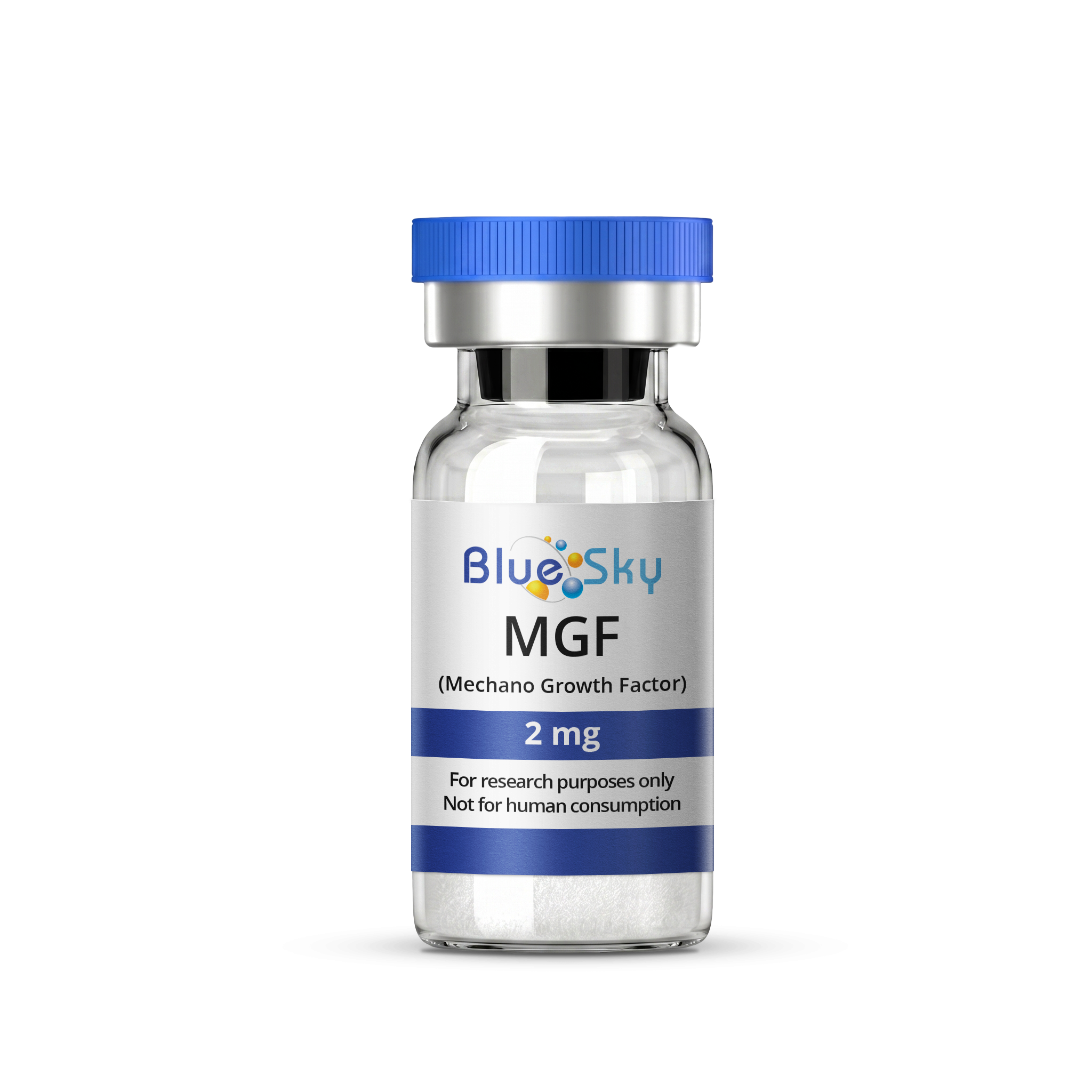
MGF Peptide (Mechano Growth Factor) 2mg

- Free Priority Shipping
- Orders over $75



Buy 1 Get 1 Free Mechano Growth Factor (MGF) 2mg :
| Unit Size | 2 mg/vial |
| Unit Quantity | 1 vial |
| Purity (Mass Spectrometry and UV) | 99.09% |
| Sequence | H-Tyr-Gln-Pro-Pro-Ser-Thr-Asn-Lys-Asn-Thr-Lys-Ser-Gln-Arg-Arg-Lys-Gly-Ser-Thr-Phe-Glu-Glu-His-Lys-NH2 |
| Molecular Formula | C121H200N42O39 |
| Appearance | Lyophilized White Powder |
| Source | Chemical Synthesis |
| Storage | Lyophilized MGF is stable at room temperature for 90 days; however, it is best stored in a freezer at -20°C for any extended period of time. |
| Terms | The products we offer are intended for laboratory research use only. Please familiarize yourself with our terms of service prior to ordering. |
| COA Verification | Verify this COA on MZ Biolabs → |
MGF Peptide (Mechano Growth Factor) 2mg
View Research Overview & References
Mechano Growth Factor (MGF) is a synthetic peptide derived from the alternative splicing of the insulin-like growth factor 1 (IGF-1) protein. Comprising 24 amino acids, MGF has a molecular mass of just over 2,866 g/mol.
Known as the MGF-24aa-E peptide, this variant results from a 49 base pair (bp) insert in the IGF-1 gene, forming a distinct isoform, IGF-1Ec.
Muscle Progenitor Cell Research
In vitro studies using muscle progenitor cells found that the MGF-E peptide activated these cells and increased their fusion potential, with this effect observed across progenitor cells derived from donors of different ages.1
Peptide Structure: The E-Domain Versus Mature IGF-1
MGF corresponds specifically to the C-terminal E-domain that is cleaved away during processing of the full IGF-1 precursor, distinguishing it structurally from the 70-amino-acid mature IGF-1 protein that retains the classic IGF-1 receptor-binding domains.
Researchers studying this splice variant have noted that the E-domain peptide's basic core, rich in lysine and arginine residues, combined with a short acidic Glu-Glu segment near the C-terminus, gives it a charge and solubility profile distinct from mature IGF-1.
Analytical Purity Verification
As a 24-residue peptide with several basic residues clustered together, MGF synthesis is prone to specific byproducts such as incomplete couplings around the arginine- and lysine-rich core, making combined HPLC and mass spectrometry verification an important step before use in signaling assays.
Storage and Handling in the Laboratory Setting
Lyophilized MGF is stored under sub-zero freezer conditions to preserve integrity prior to use, since degradation of the peptide could otherwise introduce variability into cell-based assays examining progenitor cell activation or other MGF-related signaling endpoints.
Comparative Research Context Among IGF-1 Splice Variants
MGF is frequently studied alongside other IGF-1 splice variants, including IGF-1Ea, the predominant circulating form produced in the liver.
Researchers comparing these isoforms have focused on their differential signaling behaviors, using MGF's apparent IGF-1-receptor-independent activity as a point of contrast when investigating which effects of IGF-1 gene splicing depend on classical receptor engagement versus alternative signaling routes.
What Alternative Splicing Produces
A single gene can give rise to more than one protein because the segments transcribed from it are assembled in different combinations. The 49 base pair insert that defines the IGF-1Ec transcript shifts the reading frame of the downstream sequence, so the amino acids specified after that point differ from those produced by the more common transcript.
The result is an E-domain with its own distinct sequence, which is the segment reproduced synthetically in this product. The mature IGF-1 portion of the precursor is unchanged by the insert; only the trailing domain differs.
A Strongly Basic Peptide
Counting the ionizable side chains in the sequence above gives a clear picture of this peptide's character:
- Lysine: four residues, at positions 8, 11, 16, and 24
- Arginine: two adjacent residues, at positions 14 and 15
- Histidine: one residue, at position 23
- Glutamate: two adjacent residues, at positions 21 and 22
Seven basic side chains against two acidic ones leaves the peptide carrying a substantial net positive charge near neutral pH, with a correspondingly high isoelectric point. This is why MGF behaves well in positive-ion-mode mass spectrometry and is readily retained on cation-exchange media.
The Consecutive Arginine Pair and Synthesis Difficulty
Arginine is widely regarded as the most difficult standard residue to incorporate during solid-phase synthesis. Its side chain requires a bulky protecting group, commonly Pbf, which slows the coupling step and resists removal at the end of the process.
MGF places two arginines back to back at positions 14 and 15. Sequences of this kind are a recognized source of incomplete coupling, and they also extend the final cleavage step, during which incompletely deprotected species can persist. Both outcomes are among the specific byproducts analytical testing is designed to detect.
Proline Content and Backbone Constraint
Positions 3 and 4 are both proline. Proline is unique among the standard amino acids in that its side chain loops back and bonds to the backbone nitrogen, forming a ring that locks that part of the chain into a restricted set of angles.
Two consecutive prolines near the N-terminus therefore impose a rigid segment at the start of an otherwise flexible peptide, a structural detail of interest in conformational studies of the E-domain.
Important Notice
This product is strictly intended for in vitro laboratory research use only. It is not approved for any form of human consumption, diagnostic procedures, or medical treatment. Its use is restricted to controlled research environments, and these findings do not establish safety, efficacy, or suitability for any human application.
References
1. Kandalla PK, Goldspink G, Butler-Browne G, Mouly V. Mechano Growth Factor E peptide (MGF-E), derived from an isoform of IGF-1, activates human muscle progenitor cells and induces an increase in their fusion potential at different ages. Mech Ageing Dev. 2011;132(4):154-162.
 PEG MGF 2mg$44.82
 IGF-1 LR3 1mg$85.77
 BPC 157 5mg$50.67
 Storage Case (10)$9.99


 Login