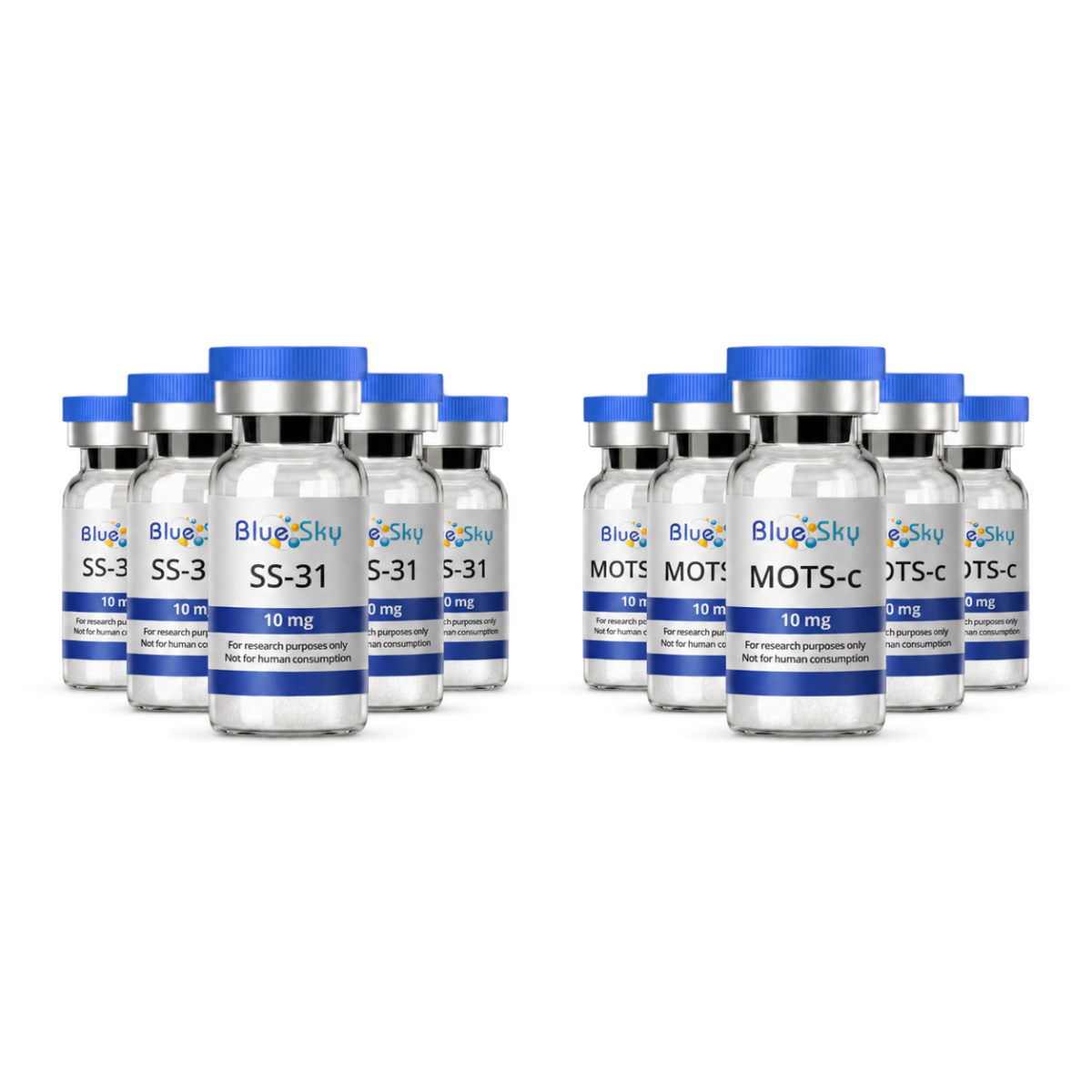
Bundle (SS-31 10 mg x5 + MOTS-c 10 mg)

- Free Priority Shipping
- Orders over $75



Buy MOTS-c 10mg:
| Unit Size | 10 mg/vial |
| Unit Quantity | 1 vial |
| Purity (Mass Spectrometry and UV) | 99.61% |
| Sequence | H-Met-Arg-Trp-Gln-Glu-Met-Gly-Tyr-Ile-Phe- Tyr-Pro-Arg-Lys-Leu-Arg-OH |
| Molecular Formula | C101H152N28O22S2 |
| Appearance | Lyophilized White Powder |
| Source | Chemical Synthesis |
| Storage | Lyophilized MOTS-c is stable at room temperature for 90 days; however, it is best stored in a freezer at -20°C for any extended period of time. |
| Terms | The products we offer are intended for laboratory research use only. Please familiarize yourself with our terms of service prior to ordering. |
| COA Verification | Verify this COA on MZ Biolabs → |
Buy SS-31 10mg:
| Unit Size | 10 mg/vial |
| Unit Quantity | 1 vial |
| Purity (Mass Spectrometry and UV) | 99.81% |
| Sequence | H-D-Arg-Tyr(2,6-diMe)-Lys-Phe-NH2 |
| Molecular Formula | C32H49N9O5 |
| Appearance | Lyophilized White Powder |
| Source | Chemical Synthesis |
| Storage | Lyophilized SS-31 is stable at room temperature for 90 days; however, it is best stored in a freezer at -20°C for any extended period of time. |
| Terms | The products we offer are intended for laboratory research use only. Please familiarize yourself with our terms of service prior to ordering. |
| COA Verification | Verify this COA on MZ Biolabs → |
Bundle: MOTS-c 10mg (x5) + SS-31 10mg (x5)
View Research Overview & References
This bundle pairs five individually-supplied vials of MOTS-c (10mg) with five individually-supplied vials of SS-31 (10mg). Both are studied in connection with mitochondrial biology, but they reach that subject from opposite directions: one is a sequence encoded within mitochondrial DNA, the other a synthetic tetrapeptide designed around membrane interaction.
MOTS-c Is Encoded Inside the Mitochondrial Genome
Most peptides in a catalog of this kind originate from nuclear genes or are designed outright. MOTS-c comes from neither. Its coding sequence sits inside the mitochondrial genome, within the 12S ribosomal RNA gene.
That places it among the mitochondrial-derived peptides, a small group of short sequences encoded by open reading frames within mitochondrial DNA rather than the nuclear DNA that specifies the overwhelming majority of a cell's proteins.
The name records this directly. MOTS-c stands for mitochondrial open reading frame of the 12S rRNA type-c, a description of where the sequence was found rather than of anything it does.
MOTS-c Nuclear Translocation Research
Cell-based research has examined where MOTS-c goes within a cell under metabolic stress, reporting that the peptide moves from the cytoplasm into the nucleus and associates with regulatory regions of nuclear genes. This describes a route by which a mitochondrially encoded sequence can participate in transcriptional regulation in the nucleus.1
SS-31 Was Designed Rather Than Discovered
The second component of this bundle has the opposite origin. SS-31 is not encoded in any genome. It is a synthetic tetrapeptide designed in a laboratory, and the initials in its name are those of the two researchers credited with the series, Szeto and Schiller.
Two of its four residues put it beyond what a ribosome could assemble in any case. The first is D-arginine rather than the L-form, and the second is a dimethylated tyrosine, an amino acid absent from the standard genetic code altogether.
So this bundle pairs a sequence read out of mitochondrial DNA with one that exists only because someone drew it.
SS-31 Membrane Interaction Research
Biophysical studies using model lipid bilayers have characterized how SS-31 associates with membranes, reporting that it binds bilayers containing anionic lipids and alters the electrostatic potential at the membrane surface, which the authors describe as a central component of its mechanism.2
The Alternating Aromatic-Cationic Pattern
Reading SS-31's four residues in order gives D-arginine, dimethyltyrosine, lysine, phenylalanine: basic, aromatic, basic, aromatic.
That alternation is the design principle behind the series rather than an accident of the sequence. Arginine and lysine supply positive charge, while the dimethyltyrosine and phenylalanine side chains supply flat aromatic surfaces. Peptides built on this pattern are described in the literature as aromatic-cationic.
The combination matters because the two residue types interact with membranes in different ways. Positive charge is drawn to the negatively charged head groups of certain membrane lipids, while aromatic rings insert into the region just beneath them. A sequence carrying both in alternation presents each kind of contact along the same very short chain.
Tyr(2,6-diMe), Also Written Dmt
The second residue appears in the specification table above as Tyr(2,6-diMe), and across much of the published literature under the shorter abbreviation Dmt. Both notations describe the same amino acid: 2,6-dimethyltyrosine, a tyrosine carrying a methyl group on each of the two ring carbons adjacent to the point where the ring joins the rest of the residue.
Placing methyl groups on both sides of that junction restricts rotation about the bond connecting the ring to the backbone. The ring is held within a narrower range of orientations than an unsubstituted tyrosine can adopt, and that conformational restriction is a principal reason the residue appears here in place of tyrosine itself.
For analysis the practical consequence is mass. The two methyl groups add 28 units over tyrosine, so a preparation carrying ordinary tyrosine at that position would appear 28 daltons below the target mass.
Four Residues Against Sixteen, But Not Four Times Lighter
MOTS-c is sixteen residues long and SS-31 is four, a ratio of exactly four to one. Their masses do not follow that ratio: roughly 2,175 against roughly 640 is closer to three and a half to one.
The reason is that SS-31 is built almost entirely from heavy residues. Arginine, dimethyltyrosine, lysine and phenylalanine are all among the larger amino acids, averaging around 160 mass units each within the chain. MOTS-c, by contrast, includes glycine, proline and other smaller residues that pull its average down to roughly 136.
This is worth keeping in mind whenever chain length is used as a shorthand for molecular size, since composition can shift the relationship considerably.
Analytical Verification Across Two Very Different Peptides
At roughly 2,175 against roughly 640, MOTS-c is more than three times the mass of SS-31, and the two present different analytical problems.
MOTS-c carries two methionines, at positions 1 and 6, which are its most readily oxidized positions, along with a single tryptophan that gives it strong ultraviolet absorbance near 280 nm. Its sixteen residues also leave room for deletion sequences that a four-residue peptide effectively cannot produce.
SS-31's analysis centers instead on confirming that its two non-standard features are the ones present: the D-configuration at position 1 and the dimethylated tyrosine at position 2. Neither is visible in a purity percentage alone, and both require identity confirmation to establish.
Each compound's certificate of analysis should be read on its own terms, since a figure for one carries no information about the other.
Studied Alongside One Another
Because both compounds are studied in relation to mitochondrial biology, this bundle supports research examining the two within a single experimental platform.
Their mechanisms are unrelated, however, and data on combining the two remains exploratory rather than established. Any research pairing them should be treated accordingly.
Storage and Handling in the Laboratory Setting
Both peptides are kept lyophilized under sub-zero freezer conditions, and because they are supplied in separate vials each can be handled according to its own sensitivities rather than a shared lowest common denominator.
MOTS-c is the more vulnerable of the two. Its two methionines and its tryptophan are all oxidation-prone side chains, and tryptophan is additionally sensitive to light, so its vials warrant more care on both counts.
SS-31 contains no methionine, no cysteine and no tryptophan. Its dimethyltyrosine and phenylalanine are comparatively stable residues, and at four residues there is very little chain available to hydrolyze.
Important Notice
MOTS-c and SS-31 are strictly for in vitro laboratory research purposes only and are not intended for human consumption. These findings do not establish safety, efficacy, or suitability for any human application, and these products have not been evaluated by the FDA or any regulatory agency.
Product Information
This bundle includes 5 vials of MOTS-c at 10mg per vial and 5 vials of SS-31 at 10mg per vial, supplied as lyophilized powders for laboratory research use only.
References
1. Kim KH, Son JM, Benayoun BA, Lee C. The Mitochondrial-Encoded Peptide MOTS-c Translocates to the Nucleus to Regulate Nuclear Gene Expression in Response to Metabolic Stress. Cell Metab. 2018 Sep 4;28(3):516-524.e7.
2. The mitochondria-targeted peptide SS-31 binds lipid bilayers and modulates surface electrostatics as a key component of its mechanism of action. J Biol Chem. 2020. PMCID: PMC7247319.
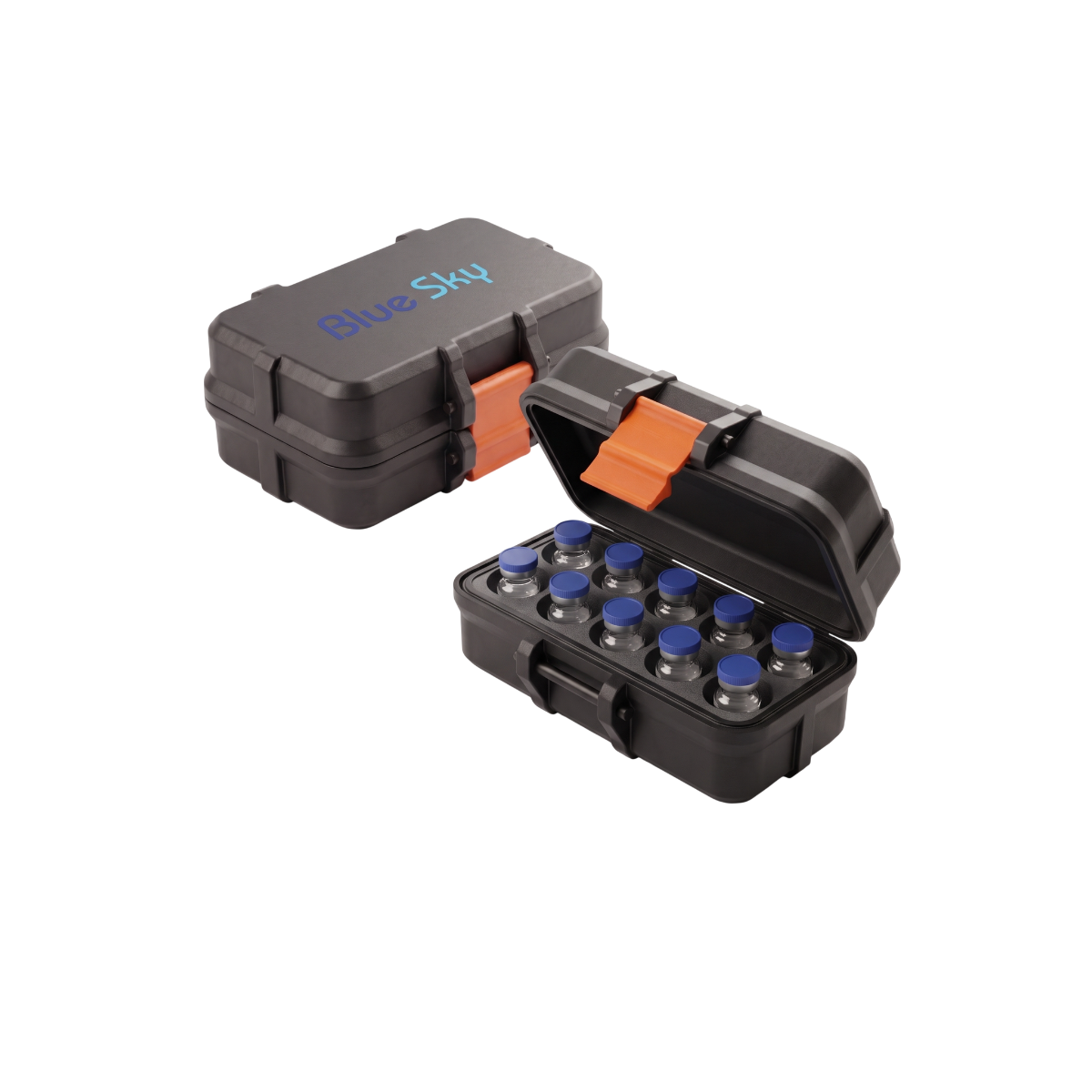
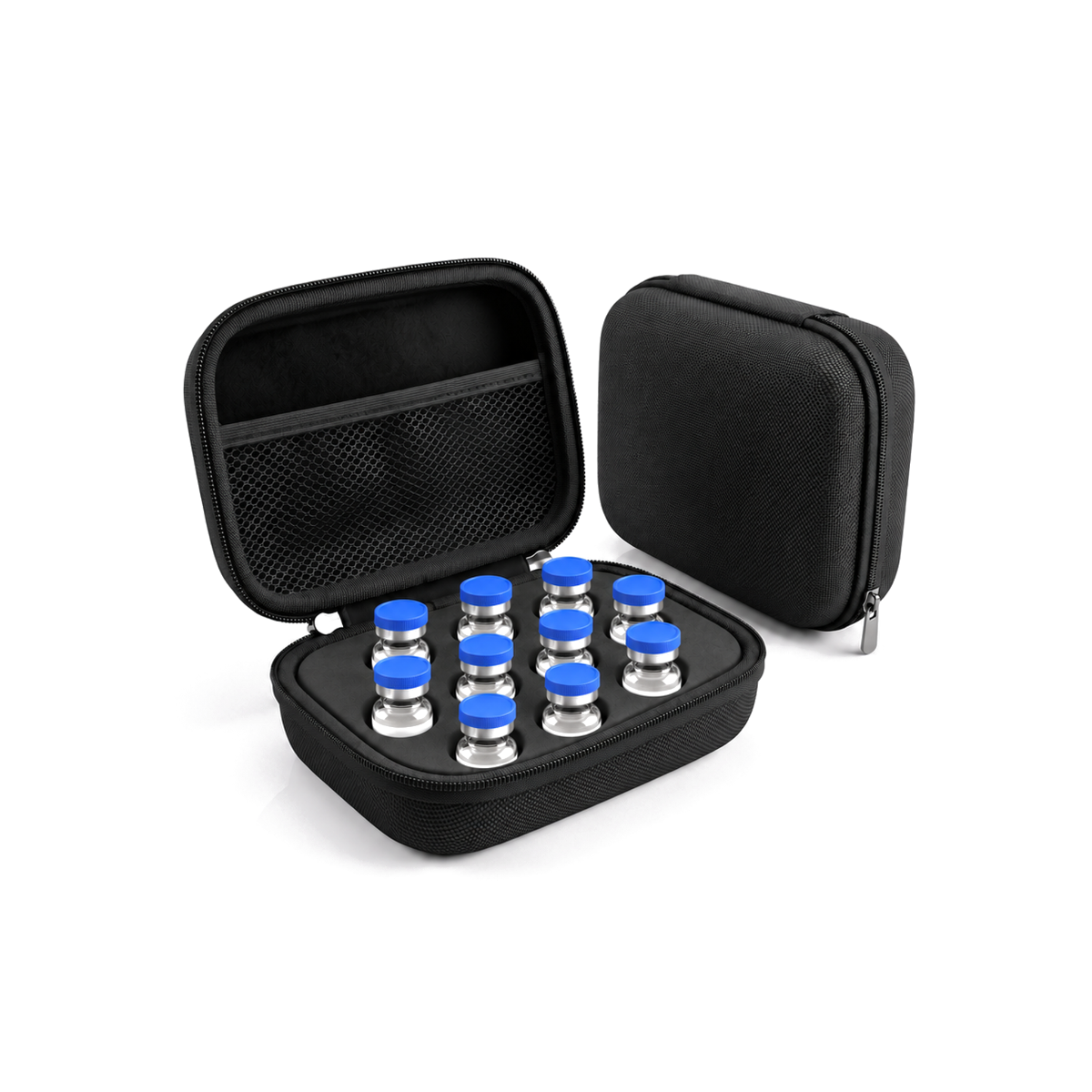 Storage Case (10)$9.99
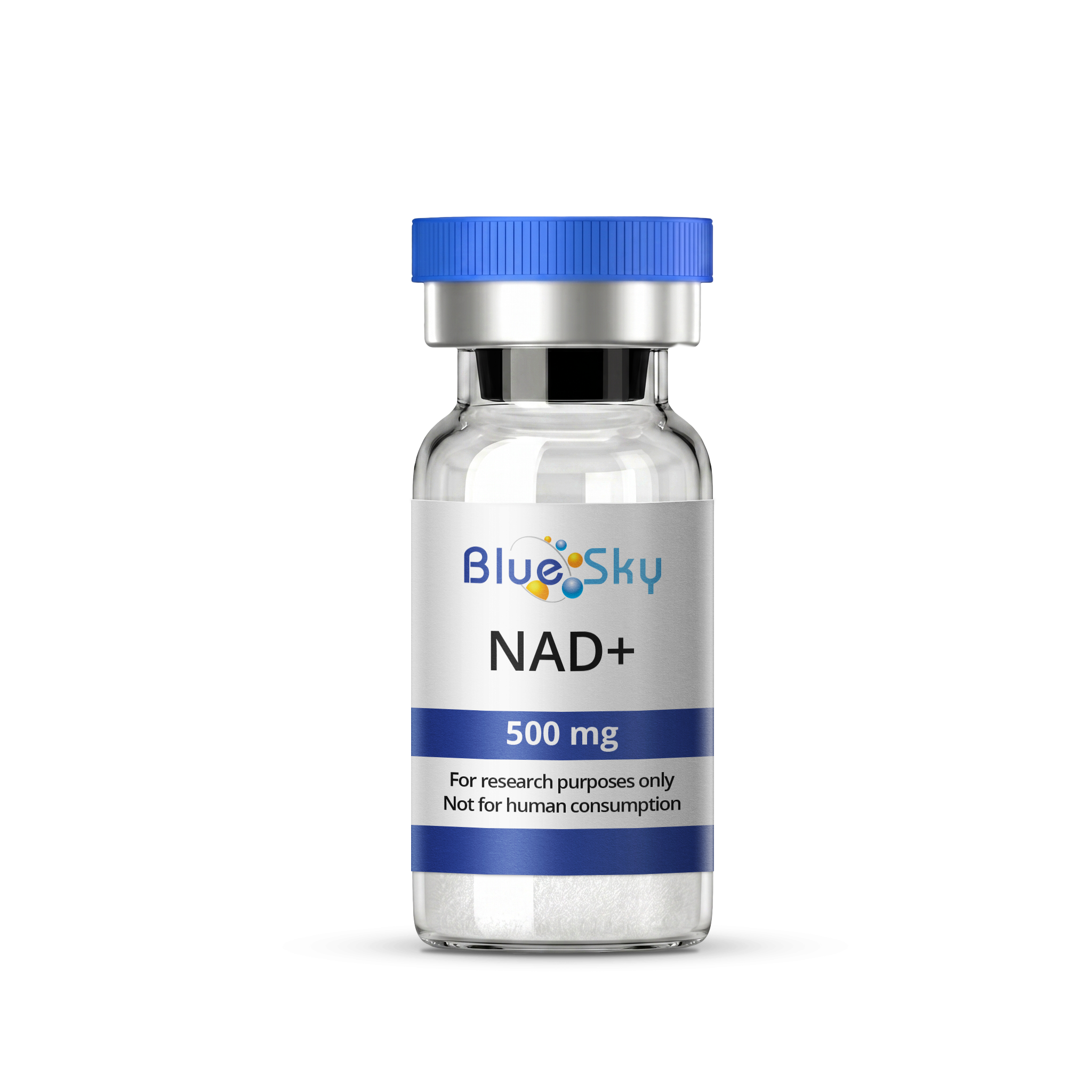 NAD+ 500mg$56.38
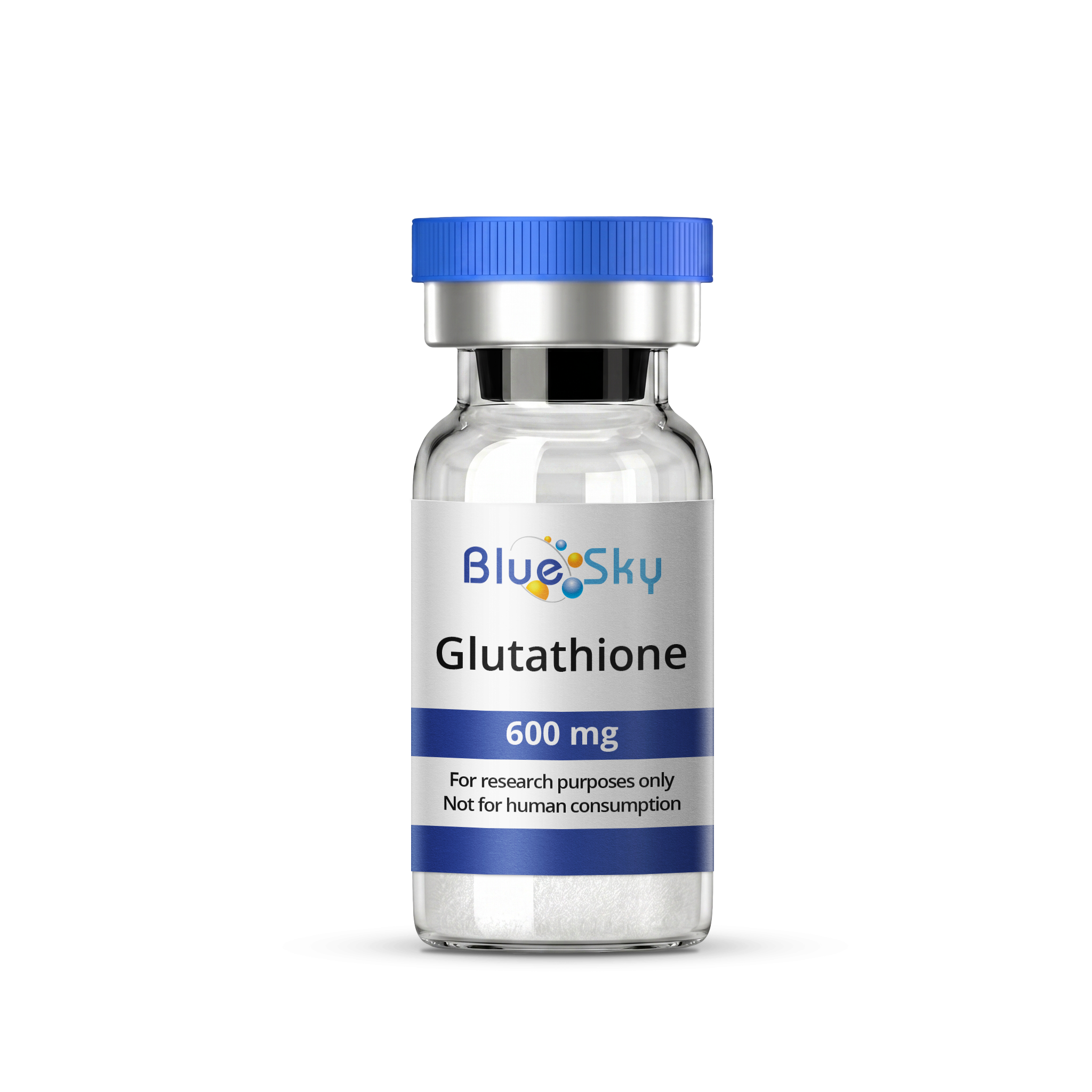 Glutathione 600mg$33.58


 Login