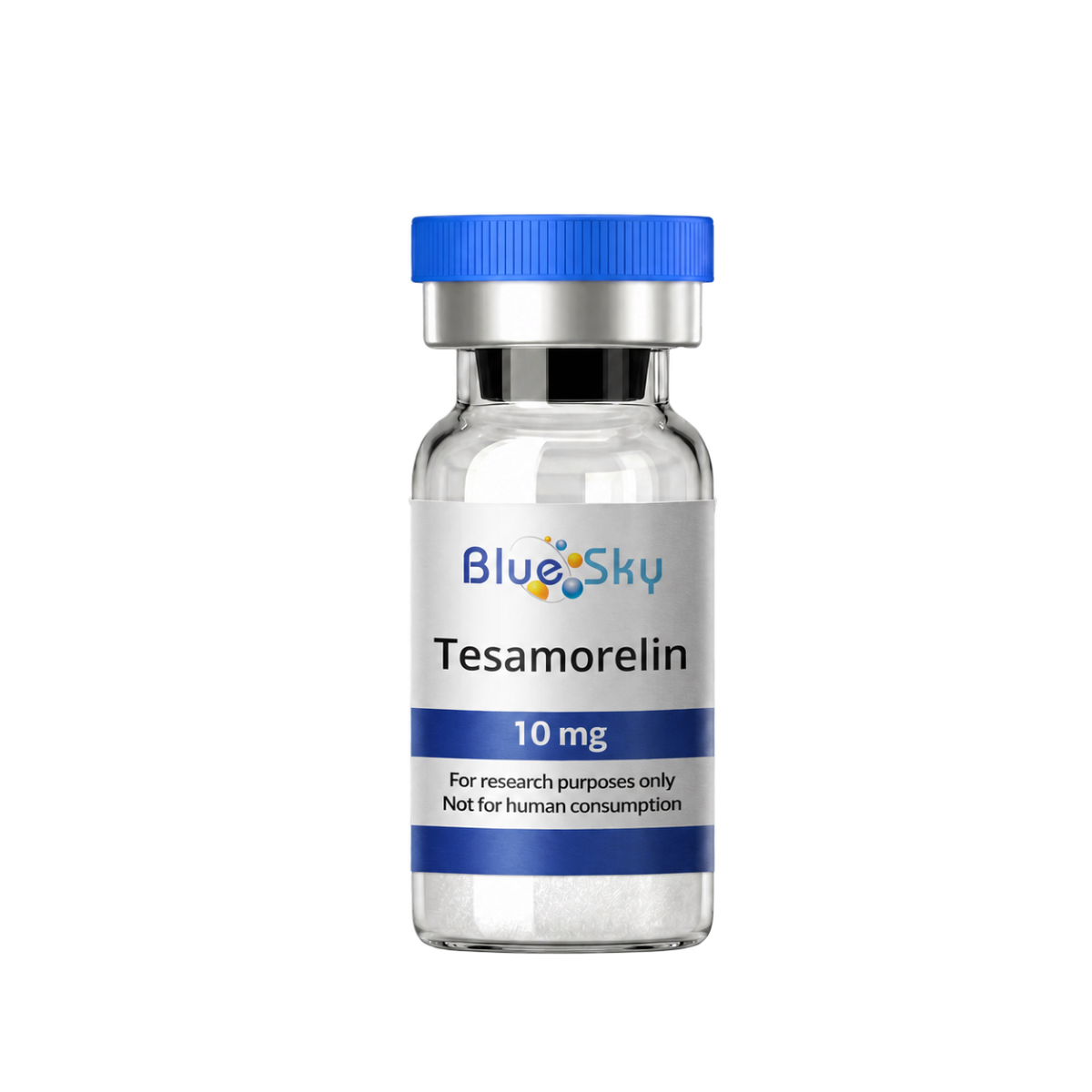
Tesamorelin 10mg

- Free Priority Shipping
- Orders over $75



Buy Tesamorelin 10mg :
| Unit Size | 10mg/vial |
| Unit Quantity | 1 vial |
| Purity (Mass Spectrometry and UV) | 99.91% |
| Sequence | (trans-3-Hexenoyl)-Tyr-Ala-Asp-Ala-Ile-Phe-Thr-Asn-Ser-Tyr-Arg-Lys-Val-Leu-Gly- Gln-Leu-Ser-Ala-Arg-Lys-Leu-Leu-Gln-Asp-Ile-Met-Ser-Arg-Gln-Gln-Gly-Glu- Ser-Asn-Gln-Glu-Arg-Gly-Ala-Arg-Ala-Arg-Leu-NH2 |
| Molecular Formula | C221H366N72O67S |
| Appearance | Lyophilized White Powder |
| Source | Chemical Synthesis |
| Storage | Lyophilized Tesamorelin is stable at room temperature for 90 days, however it is best to store in a freezer below -8°C for any extended period of time. |
| Terms | The products we offer are intended for laboratory research use only. Please familiarize yourself with our terms of service prior to ordering. |
Tesamorelin 10mg
View Research Overview
Tesamorelin is a synthetic peptide corresponding to the complete 44-amino-acid sequence of human growth hormone-releasing hormone (GHRH), chemically stabilized through two terminal modifications: a trans-3-hexenoyl group at the N-terminus and an amide at the C-terminus. This 10mg presentation provides a larger quantity of the same characterized material for laboratories conducting extended or higher-throughput in vitro studies.
In laboratory settings, tesamorelin serves as a chemically defined GHRH receptor ligand and as a structural reference for studying how terminal modifications influence peptide behavior in solution and at receptor interfaces.
Molecular Architecture
The peptide carries the full native GHRH(1–44) sequence, retaining all residues including the C-terminal tail from position 30 through 44. This region contains a concentration of polar and charged residues — glutamine, glutamate, arginine, glycine, and serine — that distinguish it from shorter truncations and influence its overall charge distribution, aggregation tendency, and aqueous solubility.
The two terminal modifications define it chemically:
- N-terminus: trans-3-hexenoyl acylation at the α-amine of Tyr1 — a six-carbon unsaturated acyl chain in the E geometric configuration
- C-terminus: primary amide (Leu-NH2), which mirrors the native peptide's own C-terminal amidation
The resulting molecule has an average molecular weight of approximately 5135.9 g/mol and a monoisotopic mass of approximately 5132.7 Da. Counterion mass from the acetate salt is additive and should be accounted for when calculating molar quantities from powder weight.
N-Terminal Acylation: Structural Role
The N-terminal Tyr-Ala dipeptide of native GHRH is a recognized substrate for dipeptidyl peptidase IV (DPP-IV), which cleaves N-terminal dipeptides from sequences with a free α-amine. Acylation of that amine with the hexenoyl chain eliminates the structural feature DPP-IV requires to act, making tesamorelin a poor substrate for this enzyme under in vitro conditions.
Beyond enzymatic considerations, the hexenoyl group introduces a short hydrophobic element at the very N-terminus — precisely the region that, according to cryo-EM structural data, inserts deepest into the receptor binding pocket [1]. The geometric configuration of the double bond is trans (E); the cis isomer would carry identical mass, making this a detail that chromatographic and NMR methods must resolve rather than mass alone.
GHRH Receptor Binding and Signaling
The GHRH receptor is a class B GPCR that couples primarily to Gαs, driving adenylyl cyclase activation and cAMP accumulation. Tesamorelin acts as an agonist at this receptor in cell-based systems, engaging it through the same contacts as native GHRH.
Structural characterization of the receptor–Gs complex by cryo-EM [1] shows the ligand adopting an α-helical conformation that contacts the receptor's extracellular domain, all three extracellular loops, and the upper portions of most transmembrane helices. The N-terminal segment contributes to receptor activation, while the C-terminal tail anchors to the receptor's extracellular domain.
Domain-mapping studies using mutant and chimeric receptor constructs established that both the receptor's N-terminal ectodomain and its transmembrane core are required for full-affinity ligand binding [2]. Radioiodinated GHRH(1–44)-amide labeled at Tyr10 was used as the displacement probe in those binding experiments [2].
Solution Stability and Degradation Pathways
The hexenoyl modification addresses enzymatic N-terminal clipping but does not alter the chemical degradation pathways intrinsic to the peptide sequence. Three positions account for most of the degradation observed in solution studies:
- Asp3: intramolecular cyclization to a succinimide intermediate, producing β-aspartyl isomers [3]
- Asn8: deamidation via the same succinimide route, also documented in related GHRH sequences [3]
- Met27: oxidation to methionine sulfoxide, accelerated by dissolved oxygen and trace metal ions
The full 44-residue sequence introduces additional glutamine and asparagine residues in the C-terminal tail beyond position 29, expanding the pool of potential deamidation sites relative to shorter GHRH fragments. The rates of all three pathways are sensitive to pH, temperature, dissolved oxygen, and elapsed time in solution.
Analytical Characterization at This Scale
At roughly 5.1 kDa, tesamorelin sits at the upper boundary of what solid-phase peptide synthesis routinely produces in high-purity form. Identity confirmation by electrospray ionization mass spectrometry yields a series of multiply charged ions; the intact mass is reconstructed from that charge-state envelope rather than read from a single peak.
Purity assessment by reversed-phase HPLC must resolve several closely related impurities:
- Des-hexenoyl tesamorelin, lacking the N-terminal acyl group
- Met27 sulfoxide species (+16 Da)
- Deamidated and β-aspartyl variants at Asp3 and Asn8
- The cis-hexenoyl geometric isomer, mass-indistinguishable from the target compound
- Synthesis-derived truncations and deletion sequences
The 10mg quantity supports multiple independent analytical runs and replicate experiments without exhausting the supply, which is relevant for method development and inter-assay reproducibility work.
Laboratory Handling and Storage
The lyophilized powder should remain sealed and cold until use. When retrieving a vial from frozen storage, allowing it to reach ambient temperature before opening prevents moisture from condensing onto the powder, which can accelerate the solution-phase degradation reactions described above.
For in vitro experiments, reconstitution volume should be calculated with the acetate salt counterion in mind. Working solutions are best prepared fresh, kept on ice and protected from light during use, and divided into single-use aliquots rather than subjected to repeated freeze-thaw cycles, which incrementally promote Met oxidation and Asp/Asn modification.
Sequence Length as an Experimental Variable
The choice between full-length tesamorelin and shorter GHRH-derived sequences is itself an experimental variable in receptor studies. The 44-residue form preserves every contact point in the native ligand, including the C-terminal anchor region, while truncated forms like GHRH(1–29) remove it. Tesamorelin combines full-sequence coverage with N-terminal enzymatic protection, making it a reference point for isolating the contribution of sequence length from that of terminal chemistry when comparing GHRH analogs side by side.
References
- Zhou F, Zhang H, Cong Z, et al. Structural basis for activation of the growth hormone-releasing hormone receptor. Nat Commun. 2020;11:5205. doi:10.1038/s41467-020-18945-0
- DeAlmeida VI, Mayo KE. Identification of binding domains of the growth hormone-releasing hormone receptor by analysis of mutant and chimeric receptor proteins. Mol Endocrinol. 1998;12(5):750–765.
- Bongers J, Heimer EP, Lambros T, Pan YCE, Campbell RM, Felix AM. Degradation of aspartic acid and asparagine residues in human growth hormone-releasing factor. Int J Pept Protein Res. 1992;39:364–374.
Important Notice
Tesamorelin is provided exclusively for laboratory research purposes (in vitro). This peptide is not intended for human consumption or use, and any application outside of controlled laboratory research is prohibited. These findings do not establish safety, efficacy, or suitability for any human application, and have not been evaluated by the FDA or any regulatory agency.
Product Information
Tesamorelin 10mg is supplied as a lyophilized powder for laboratory research use only.


 Login