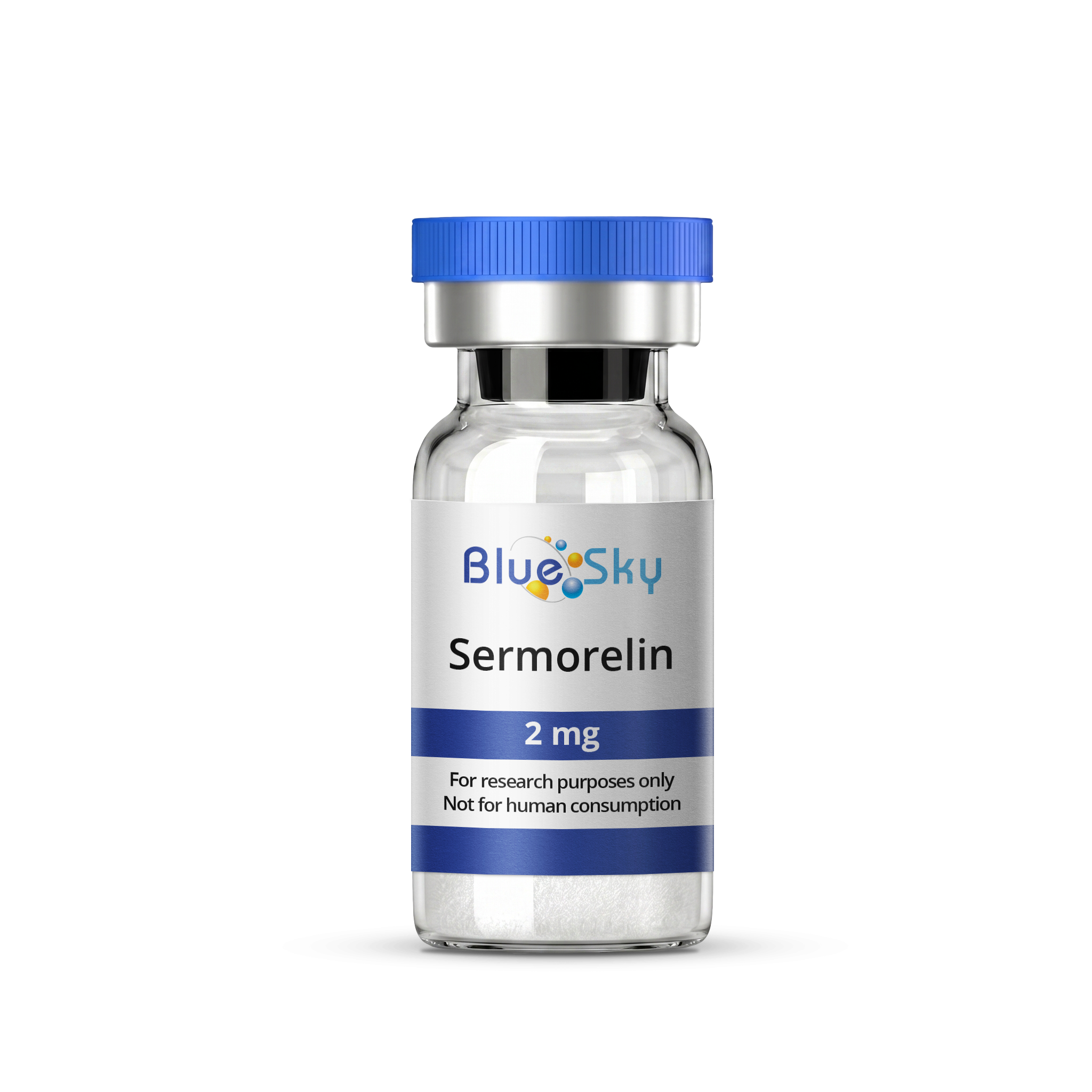
Sermorelin 2mg

- Free Priority Shipping
- Orders over $75



Buy 1 Get 1 Free Sermorelin 2mg :
| Unit Size | 2 mg/vial |
| Unit Quantity | 1 vial |
| Purity (Mass Spectrometry and UV) | 99.16% |
| Sequence | H-Tyr-Ala-Asp-Ala-Ile-Phe-Thr-Asn-Ser-Tyr-Arg-Lys-Val-Leu-Gly-Gln-Leu- Ser-Ala-Arg-Lys-Leu-Leu-Gln-Asp-Ile-Met-Ser-Arg-NH2 |
| Molecular Formula | C149H246N44O42S |
| Appearance | Lyophilized White Powder |
| Source | Chemical Synthesis |
| Storage | Lyophilized Sermorelin is stable at room temperature for 90 days; however, it is best stored in a freezer at -20°C for any extended period of time. |
| Terms | The products we offer are intended for laboratory research use only. Please familiarize yourself with our terms of service prior to ordering. |
| COA Verification | Verify this COA on MZ Biolabs → |
Sermorelin 2mg
View Research Overview
Sermorelin is a synthetic 29-amino-acid peptide corresponding to the N-terminal segment (residues 1–29) of growth hormone-releasing hormone (GHRH), with a C-terminal amide.
In laboratory research, it is studied in vitro as a ligand for the GHRH receptor, a class B G protein-coupled receptor (GPCR). Its compact length makes it a practical model peptide for receptor-binding and peptide-stability studies.
Peptide Structure and Chemistry
Native GHRH is 44 residues long. The 1–29 segment contains the region responsible for receptor activation, so it is widely used in research as a shorter, synthetically accessible stand-in for the full-length peptide.
Sermorelin's C-terminus is amidated (Arg-NH2), removing the free carboxyl group. Its free N-terminal tyrosine, by contrast, is left unmodified, which has consequences for enzymatic stability described below.
Native GHRH adopts an α-helical conformation when bound to its receptor [1], and the 1–29 segment spans much of that helix. In plain aqueous buffer, short peptides of this type are generally more flexible, with helix content increasing in membrane-like or helix-promoting environments.
Key residues for laboratory handling include:
- Asp3 and Asn8, the main sites of chemical rearrangement in solution [3]
- Met27, the only sulfur-containing residue and the primary oxidation site
- Tyr1 and Tyr10, the two tyrosines, which account for its absorbance at 280 nm, since the sequence contains no tryptophan
Primary Mechanism of Action
In vitro, sermorelin acts as an agonist at the GHRH receptor. Like other class B GPCRs, this receptor has a large N-terminal extracellular domain in addition to its seven transmembrane helices.
Class B receptors are generally described by a two-step binding model. The C-terminal portion of the peptide helix docks onto the extracellular domain, while the N-terminal portion inserts into the transmembrane core to activate the receptor.
Cryo-EM analysis of the GHRH receptor bound to its native ligand supports this picture. The peptide helix contacts the extracellular domain, the extracellular loops, and most transmembrane helices, while its N-terminus forms a broad set of specific interactions within the receptor core [1].
The receptor couples primarily to Gαs. Downstream signaling studied in cell-based assays includes:
- Adenylyl cyclase activation
- Cyclic AMP (cAMP) accumulation [2]
- Protein kinase A (PKA) activation
- Phosphorylation of the transcription factor CREB
In Vitro Research Findings
Receptor mapping studies have used engineered cell lines to identify which parts of the GHRH receptor are required for ligand recognition [2].
In one study, truncated receptors lacking either the N-terminal domain or the membrane-spanning region failed to bind GHRH. Neither domain alone was sufficient [2].
Chimeric receptors pairing the GHRH receptor's transmembrane region with the N-terminal domain of related receptors still bound GHRH and stimulated cAMP. The reverse chimeras did not [2]. This pointed to the transmembrane domains and extracellular loops as key determinants of binding specificity.
The later receptor structure added residue-level detail, using mutagenesis and molecular dynamics alongside cryo-EM to map how the ligand engages the receptor [1].
Chemical and Enzymatic Stability
Sermorelin's degradation pathways are well characterized, which matters for any laboratory preparing solutions or interpreting analytical data.
Chemical rearrangement. In aqueous solution, Asp3 and Asn8 can cyclize through a succinimide intermediate. This produces deamidated and isomerized (β-aspartyl) forms of the peptide [3]. These reactions depend on pH, temperature, and time in solution.
Oxidation. Met27 can oxidize to methionine sulfoxide, adding 16 Da to the peptide mass. Exposure to air, light, and trace metals in buffers accelerates this.
Enzymatic cleavage. The N-terminal Tyr-Ala sequence is a recognition motif for dipeptidyl peptidase IV (DPP-IV), which removes the first two residues. Laboratories working with biological matrices such as serum or cell-culture media should account for this cleavage.
Analytical Purity Verification
Sermorelin batches are typically verified by reversed-phase HPLC with UV detection for purity, combined with mass spectrometry for identity. For this peptide, analytical checks commonly look for:
- Truncated or deletion sequences from synthesis
- Met27 sulfoxide (+16 Da)
- Deamidation products at Asn8 (+1 Da)
- Isomerized Asp3 forms, which have the same mass and require HPLC separation
- The 3–29 fragment left after N-terminal dipeptide loss
The average molecular weight of the C149H246N44O42S peptide is approximately 3357.9 g/mol. The monoisotopic mass, approximately 3355.8 Da, is the reference value used when interpreting high-resolution mass spectrometry data. Material in acetate salt form carries a higher formula weight.
Storage and Handling in the Laboratory Setting
Lyophilized sermorelin is far more stable than material in solution. Laboratories typically keep vials frozen and sealed, and allow them to reach room temperature before opening to limit moisture uptake.
Once reconstituted, the rearrangement and oxidation pathways described above become active. Common laboratory practice is to prepare solutions close to use, keep them refrigerated, protect them from light, and aliquot to limit freeze–thaw cycles.
References
- Zhou F, Zhang H, Cong Z, et al. Structural basis for activation of the growth hormone-releasing hormone receptor. Nat Commun. 2020;11:5205. doi:10.1038/s41467-020-18945-0
- DeAlmeida VI, Mayo KE. Identification of binding domains of the growth hormone-releasing hormone receptor by analysis of mutant and chimeric receptor proteins. Mol Endocrinol. 1998;12(5):750–765.
- Bongers J, Heimer EP, Lambros T, Pan YCE, Campbell RM, Felix AM. Degradation of aspartic acid and asparagine residues in human growth hormone-releasing factor. Int J Pept Protein Res. 1992;39:364–374.
Important Notice
Sermorelin is provided exclusively for laboratory research purposes (in vitro). This peptide is not intended for human consumption or use, and any application outside of controlled laboratory research is prohibited. These findings do not establish safety, efficacy, or suitability for any human application, and have not been evaluated by the FDA or any regulatory agency.
Product Information
Sermorelin is supplied as a lyophilized powder for laboratory research use only.
 Tesamorelin 5mg$61.72
 IPAMORELIN 2000mcg$27.27
 CJC-1295 W-DAC 2mg$32.47
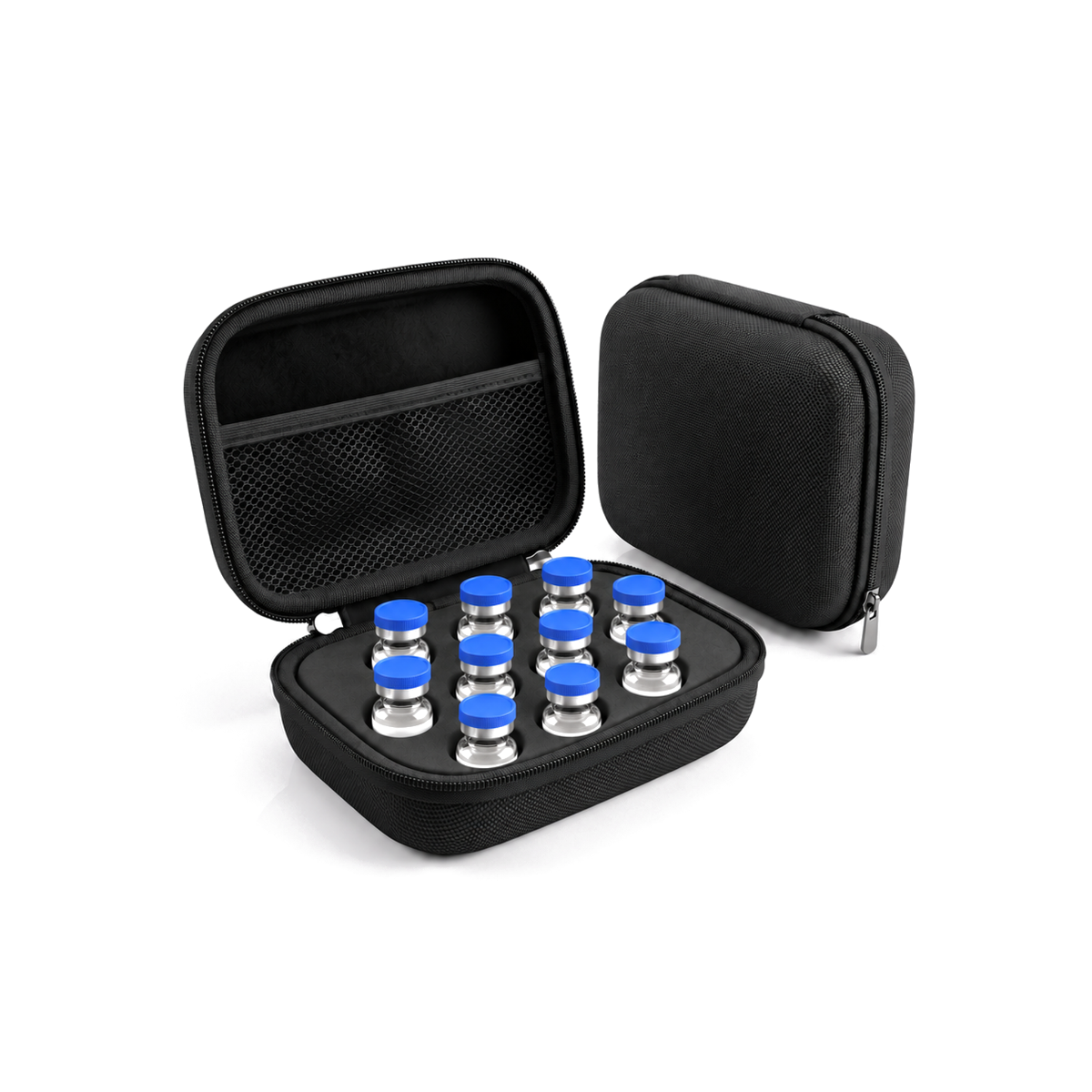 Storage Case (10)$9.99


 Login