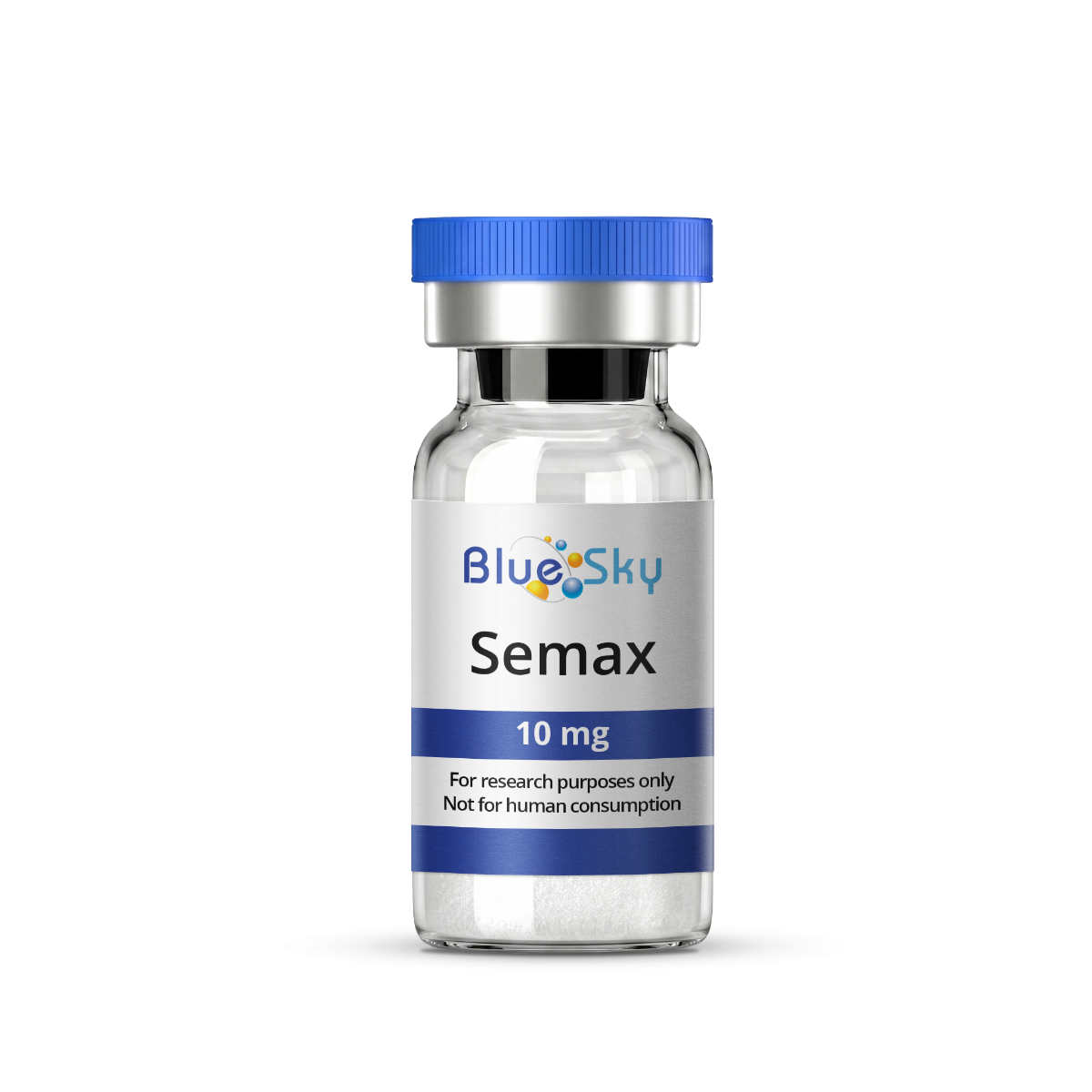
SEMAX 10mg

- Free Priority Shipping
- Orders over $75



Buy Semax 10mg :
| Unit Size | 10 mg/vial |
| Unit Quantity | 1 vial |
| Purity (Mass Spectrometry and UV) | 99% |
| Sequence | H-Met-Glu-His-Phe-Pro-Gly-Pro-OH |
| Molecular Formula | C37H51N9O10S |
| Appearance | Lyophilized White Powder |
| Source | Chemical Synthesis |
| Storage | Lyophilized Semax is stable at room temperature for 90 days, however it is best to store in a freezer below -8°C for any extended period of time. After reconstitution, Semax should be refrigerated at temperatures not to exceed 35°F. |
| Terms | The products we offer are intended for laboratory research use only. Please familiarize yourself with our terms of service prior to ordering. |
Semax 10mg
View Research Overview
Semax is a synthetic heptapeptide derived from the 4–10 fragment of adrenocorticotropic hormone (ACTH), a member of the melanocortin peptide family. Its sequence couples that ACTH-derived segment to a C-terminal proline-glycine-proline (Pro-Gly-Pro) motif.
In laboratory research, it is studied in vitro as a melanocortin-related peptide ligand and as a model for how a stabilizing C-terminal motif changes the behavior of a short peptide.
Peptide Structure and Chemistry
Semax is seven residues long with the sequence Met-Glu-His-Phe-Pro-Gly-Pro. The first four residues correspond to ACTH(4–7); the C-terminal Pro-Gly-Pro tripeptide is appended in place of the native ACTH(8–10) sequence.
Its notable structural features include:
- N-terminal methionine: the only sulfur-containing residue, and the primary oxidation site
- His-Phe core: an aromatic pair that is part of the conserved melanocortin recognition region
- C-terminal Pro-Gly-Pro: a proline-rich motif that confers resistance to many aminopeptidases and carboxypeptidases
Both termini are unmodified, leaving a free N-terminal amine and a free C-terminal carboxyl. The glutamate, histidine and free terminal groups together give the peptide good aqueous solubility.
Role of the Proline-Glycine-Proline Motif
Proline is unique among the standard amino acids: its side chain loops back to the backbone nitrogen, forming a ring that constrains the peptide bond and blocks many proteases that require a flexible, extended substrate.
A Pro-Gly-Pro arrangement is a well-studied stabilizing motif in peptide chemistry. The two prolines flank a small, flexible glycine, giving the C-terminus both conformational constraint and resistance to exopeptidase trimming from that end.
This is why Semax is often cited as an example of how appending a glyproline fragment to a bioactive sequence can extend a short peptide's working lifetime in biochemical media relative to the unmodified parent fragment.
Melanocortin Receptor Family Context
Because its N-terminal segment is drawn from ACTH, Semax belongs chemically to the melanocortin ligand family. The melanocortin receptors (MC1R through MC5R) are class A G protein-coupled receptors (GPCRs) that couple primarily to Gαs and raise intracellular cyclic AMP (cAMP).
The conserved recognition element shared across melanocortin peptides is a central His-Phe-Arg-Trp sequence. Semax retains the His-Phe portion of that motif but not the full tetrapeptide, which is consistent with its being studied as a partial or modified melanocortin ligand rather than a full agonist.
Structural biology of this receptor family provides the reference framework for such work. A cryo-EM structure of the melanocortin-4 receptor (MC4R) bound to a peptide agonist and the Gs protein has mapped how melanocortin peptides occupy the binding pocket [1].
An earlier crystal structure of MC4R identified a calcium ion (Ca2+) bound jointly to the receptor and its peptide ligand, and showed that extracellular Ca2+ markedly increases the affinity of the native agonist [2]. This makes calcium concentration a relevant variable in any melanocortin-receptor binding assay.
Relationship to the Parent ACTH Fragment
Semax is a clear illustration of fragment-based peptide design. The starting point is ACTH(4–10), a short natural segment of a much larger hormone; Semax keeps its first four residues and replaces the rest with the Pro-Gly-Pro motif.
Comparing a modified peptide against its parent fragment is a common in vitro exercise. Held side by side, the two let researchers separate the contribution of the retained recognition residues from the contribution of the appended stabilizing motif, across measures such as solution stability and receptor binding.
This design logic—keep the recognition core, modify the periphery for stability—recurs throughout synthetic peptide chemistry, which is part of why short ACTH-derived sequences remain useful reference compounds.
In Vitro Assay Considerations
Melanocortin-related peptides are typically profiled in receptor-expressing cell lines, using assay formats that match the receptors' Gαs coupling:
- cAMP
45% Off SITEWIDE
NO PROMO CODE REQUIRED


 Login
Login