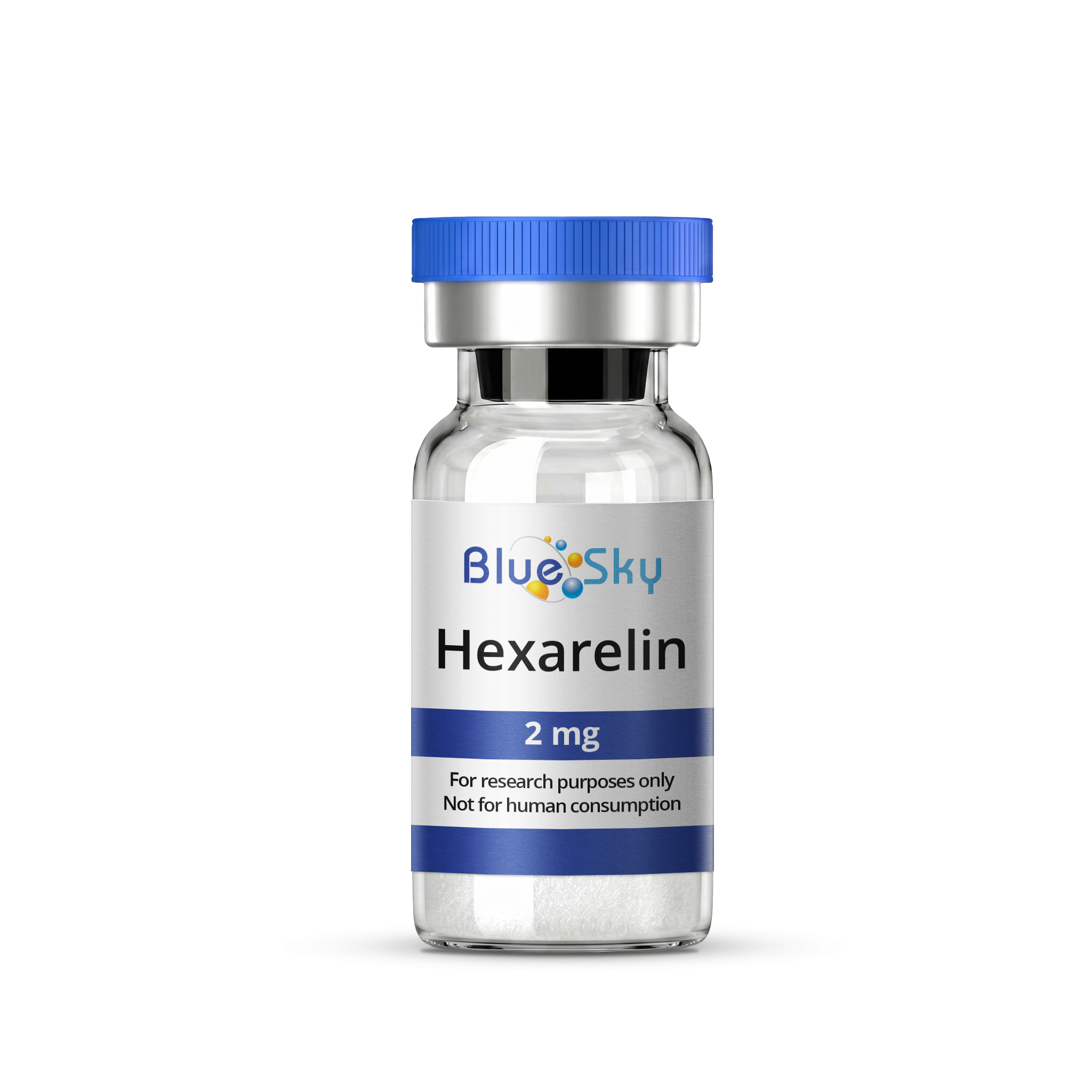
HEXARELIN 2mg

- Free Priority Shipping
- Orders over $75



Buy 1 Get 1 Free HEXARELIN 2mg :
| Unit Size | 2 mg/vial |
| Unit Quantity | 1 vial |
| Purity (Mass Spectrometry and UV) | 96.53% |
| Sequence | His-D-2-Me-Trp-Ala-Trp-D-Phe-Lys-NH2 |
| Molecular Formula | C47H58N12O6 |
| Appearance | Lyophilized White Powder |
| Source | Chemical Synthesis |
| Storage | Lyophilized HEXARELIN is stable at room Temperature for 90 days, however it is best to store in a freezer below - 8c for any extended period of time. |
| Terms | The products we offer are intended for laboratory research use only. Please familiarize yourself with our terms of service prior to ordering. |
HEXARELIN 2mg
View Research Overview & References
Hexarelin is a synthetic analog of the gastrointestinal peptide ghrelin, studied in vitro for its interaction with the growth hormone secretagogue receptor (GHS-R1a). Unlike ghrelin, hexarelin also binds to the CD36 receptor, imparting additional receptor-binding properties of research interest.
Cell-Based Neuroprotection Signaling Research
In vitro studies using Neuro-2A cells, an established murine neuroblastoma cell line, found that hexarelin modulated MAP kinase and PI3K/Akt signaling pathways and reduced hydrogen peroxide-induced apoptotic toxicity within this cell-based system.1
Peptide Structure and Stabilizing Modifications
Hexarelin's structure builds on the earlier GHRP-6 scaffold with an additional modification: a methyl group added to the D-tryptophan residue, distinguishing it from GHRP-6's unmethylated D-tryptophan at the corresponding position.
Researchers studying structure-activity relationships among GHRP-class secretagogues have linked this 2-methyl substitution to hexarelin's reported higher binding affinity at GHS-R1a relative to earlier secretagogues in this peptide family, alongside the D-phenylalanine substitution shared with GHRP-6 that contributes to resistance against enzymatic cleavage in laboratory assay systems.
CD36 Receptor Binding as a Distinguishing Feature
Unlike GHRP-6 or ipamorelin, hexarelin is studied for a secondary interaction with the CD36 scavenger receptor, a binding property not shared by other secretagogues built on the classical GHRP scaffold.
This dual-receptor profile makes hexarelin a distinct tool compound in receptor-binding assay design when researchers specifically want to probe CD36-mediated signaling alongside or separate from classical GHS-R1a activity.
Analytical Purity Verification
Hexarelin's two indole-containing tryptophan-derived residues, one bearing a 2-methyl substitution, are prone to side reactions during solid-phase synthesis.
Purity testing combining HPLC and mass spectrometry is used to confirm correct sequence assembly and rule out byproducts arising from these reactive residues.
Storage and Handling in the Laboratory Setting
Lyophilized hexarelin is stored under sub-zero freezer conditions to preserve integrity between experimental sessions.
Given the light sensitivity associated with indole-containing tryptophan residues, researchers handling this compound also limit its exposure to light in addition to standard cold-storage practices used across other secretagogue research peptides.
Important Notice
Hexarelin is intended exclusively for laboratory research use (in vitro) and is not approved for human use. This product has not been evaluated for safety or efficacy in humans. Any use for diagnostic or therapeutic applications is strictly prohibited.
References
1. Meanti R, Rizzi L, Bresciani E, Molteni L, Locatelli V, Coco S, Omeljaniuk RJ, Torsello A. Hexarelin modulation of MAPK and PI3K/Akt pathways in Neuro-2A cells inhibits hydrogen peroxide-induced apoptotic toxicity. Pharmaceuticals (Basel). 2021 May 8;14(5):444.
 Buy Bulk Sermorelin 2mg$51.95
 Buy Bulk MELANOTAN II 10mg$49.95


 Login
Login