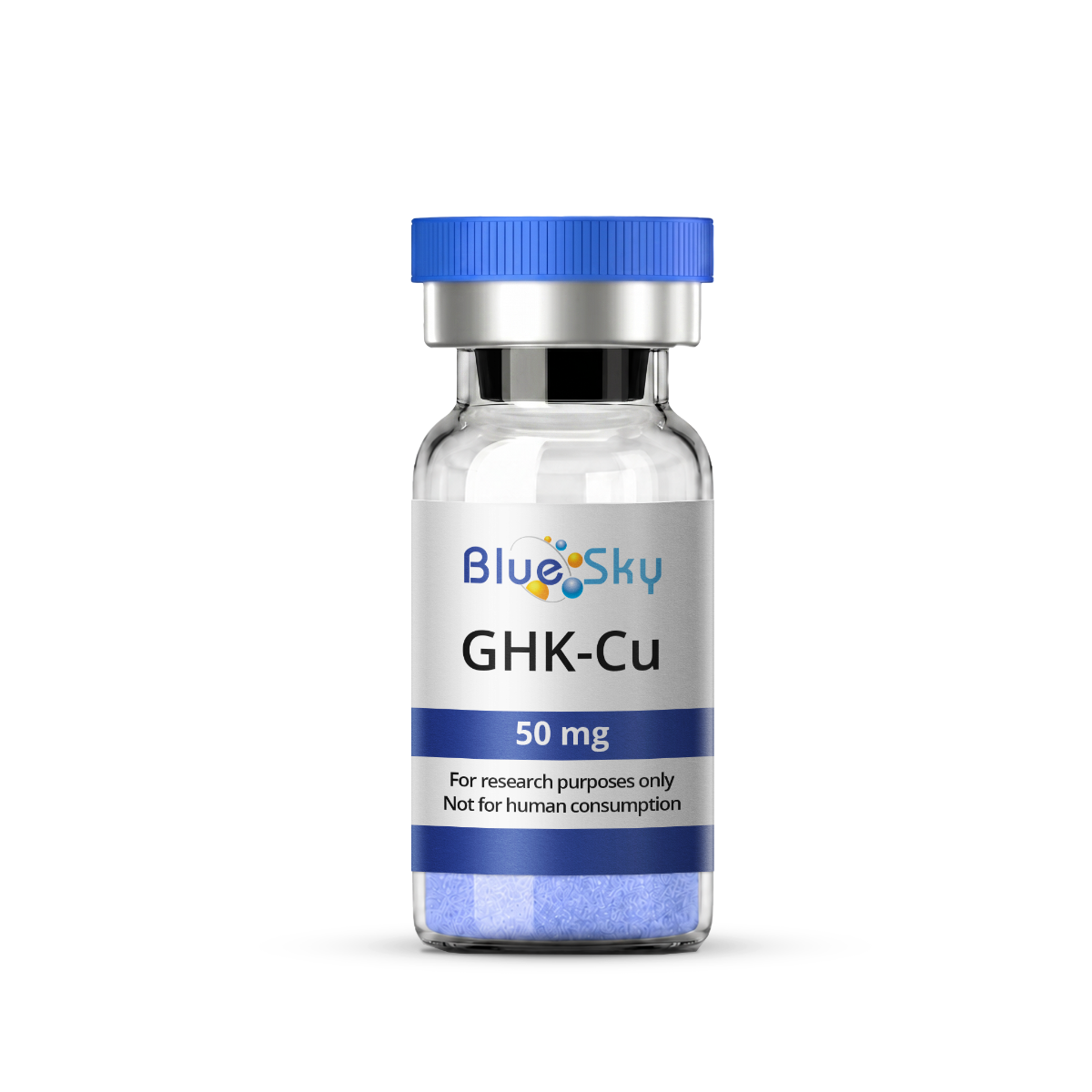
GHK-Cu 50mg Copper Peptide

- Free Priority Shipping
- Orders over $75



GHK-Cu 50mg Copper Peptide :
| Unit Size | 50mg/vial |
| Unit Quantity | 1 vial |
| Purity (Mass Spectrometry and UV) | 99.96% |
| Sequence | Gly-His-Lys.Cu.xHAc |
| Molecular Formula | C14H22CuN6O4 |
| Appearance | Lyophilized Powder |
| Source | Chemical Synthesis |
| Storage |
Lyophilized GHK-Cu 50mg Copper Peptide is stable at room Temperature for 90 days, however it is best to store in a freeze below - 8c for any extended period of time. |
| Terms | The products we offer are intended for laboratory research use only. Please familiarize yourself with our terms of service prior to ordering. |
GHK-Cu 50mg Copper Peptide
View Research Overview & References
GHK-Cu, or Glycyl-L-Histidyl-L-Lysine Copper(II), is a synthetic copper peptide created by chelating the GHK peptide with copper ions. It is studied in vitro for its effects on cell signaling pathways related to fibroblast growth factor production and cell proliferation.
Cell Culture Growth Factor Research
In vitro studies using primary human dermal fibroblasts, established from surgical specimens, found that GHK-Cu affected cell growth and the autocrine production of basic fibroblast growth factor (bFGF), transforming growth factor beta-1, and vascular endothelial growth factor (VEGF) in both normal and previously irradiated fibroblast cultures.1
These growth factors are studied more broadly in cell biology research for their roles in epithelial repair and angiogenesis-related signaling.2,3
Bone Cell Culture Research
In vitro studies using cultured osteoblastic cells found that the GHK-copper complex affected cell spreading, attachment behavior, and phenotype markers in these bone-forming cell cultures.4
Peptide-Copper Coordination Chemistry
GHK-Cu is studied by peptide chemists as a model system for copper coordination, since the tripeptide's glycine amine, deprotonated backbone amide nitrogen, and histidine imidazole ring together form a square-planar binding pocket for the Cu2+ ion.
This coordination geometry closely resembles the copper-binding motif found in human serum albumin, making GHK-Cu a frequently cited reference structure in laboratory studies of metal-peptide binding behavior. Researchers examining structure-activity relationships in copper-binding peptides often use this coordination arrangement as a comparative baseline when evaluating synthetic analogs with modified metal affinity.
Analytical Purity and Copper Content Verification
Because GHK-Cu is a metal-peptide complex rather than a purely organic molecule, analytical verification in the laboratory setting typically involves confirming both peptide sequence purity and correct copper stoichiometry.
High-performance liquid chromatography (HPLC) and mass spectrometry are used to confirm the intact complex mass and rule out unchelated GHK peptide or incomplete synthesis byproducts, while the characteristic copper isotope pattern observed in mass spectrometry provides additional confirmation of proper metal incorporation.
Storage and Handling in the Laboratory Setting
Copper-chelated peptides such as GHK-Cu are generally more resistant to enzymatic degradation than their unchelated peptide counterparts, since metal coordination can shield the peptide backbone from proteolytic cleavage.
Even so, laboratories typically store lyophilized material under sub-zero freezer conditions to preserve long-term stability. Because copper ions can participate in redox chemistry, researchers working with this compound in cell-based assays often account for potential interactions with other redox-sensitive assay components when designing experimental controls.
Comparative Research Context Among Copper-Binding Peptides
GHK-Cu is frequently referenced in laboratory literature alongside other naturally occurring copper-binding peptide motifs, including the broader family of ATCUN (amino-terminal Cu(II) and Ni(II) binding) motif peptides studied in bioinorganic chemistry research.
Researchers investigating metal-peptide interactions in cell signaling contexts often cite GHK-Cu's well-characterized coordination chemistry as a benchmark when evaluating newer synthetic copper-binding peptides for laboratory use.
Important Notice
This GHK-Cu product is strictly intended for in vitro laboratory research only and is not suitable for human or therapeutic use. Any use outside of controlled laboratory settings is prohibited, and these findings do not establish safety, efficacy, or suitability for any human application.
References
1. Pollard JD, Quan S, Kang T, Koch RJ. Effects of copper tripeptide on the growth and expression of growth factors by normal and irradiated fibroblasts. Arch Facial Plast Surg. 2005;7(1):27-31.
2. Steiling H, Werner S. Fibroblast growth factors: key players in epithelial morphogenesis, repair, and cytoprotection. Curr Opin Biotechnol. 2003;14(5):533-537.
3. Powers CJ, McLeskey SW, Wellstein A. Fibroblast growth factors, their receptors, and signaling. Endocr Relat Cancer. 2000;7(3):165-197.
4. Godet D, Marie PJ. Effects of the tripeptide glycyl-L-histidyl-L-lysine copper complex on osteoblastic cell spreading, attachment, and phenotype. Cell Mol Biol (Noisy-le-grand). 1995;41(8):1081-1091.


 Login
Login