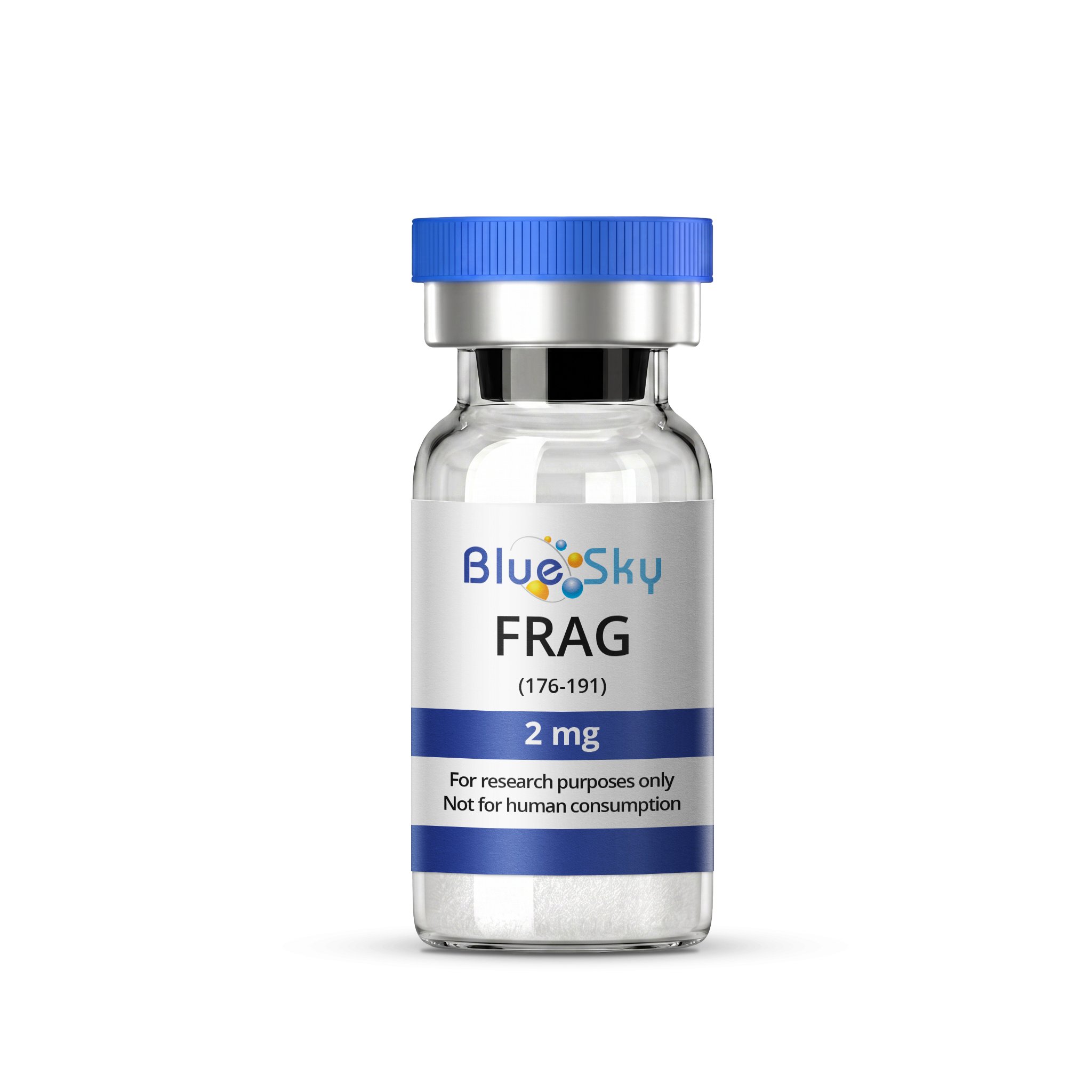
FRAGMENT 176-191 2mg

- Free Priority Shipping
- Orders over $75



Buy 1 Get 1 Free FRAGMENT 176-191 2mg :
| Unit Size | 2 mg/vial |
| Unit Quantity | 1 vial |
| Purity (Mass Spectrometry and UV) | 99.56% |
| Sequence | H-Tyr-Leu-Arg-Ile-Val-Gln-Cys-Arg-Ser-Val-Glu-Gly-Ser-Cys-Gly-Phe-OH |
| Molecular Formula | C78H123N23O23S2 |
| Appearance | Lyophilized White Powder |
| Source | Chemical Synthesis |
| Storage |
Lyophilized FRAGMENT 176-191 is stable at room Temperature for 90 days, however it is best to storer in a freeze below - 8c for any extended period of time.. |
| Terms | The products we offer are intended for laboratory research use only. Please familiarize yourself with our terms of service prior to ordering. |
FRAGMENT 176-191 2mg
View Research Overview & References
Fragment 176-191 is a synthetic peptide analog of human growth hormone (hGH) consisting of 16 amino acids from the C-terminus of hGH, spanning positions 176 to 191.1
In Vitro Genetic Toxicology Screening
Standard laboratory genotoxicity screening for this hGH fragment has included a bacterial reverse mutation assay and a cultured mammalian cell chromosomal aberration test, alongside general cytotoxicity screening in cell-based systems.2
Distinction from the Natural hGH C-Terminal Sequence
Fragment 176-191 differs from the unmodified, naturally occurring C-terminal region of human growth hormone through a deliberate tyrosine-for-phenylalanine substitution and an added N-terminal tyrosine residue relative to some earlier linear fragment designs studied in the literature.
Researchers examining structure-activity relationships in GH-derived fragments have used this modified sequence to probe which structural elements of the native C-terminal domain are necessary for the peptide's studied receptor-interaction behavior, independent of the growth-promoting domains found elsewhere in the full-length hormone.
Receptor Engagement Distinct from the IGF-1 Axis
A recurring theme in laboratory research on Fragment 176-191 is its structural separation from the region of hGH responsible for stimulating insulin-like growth factor-1 (IGF-1) release, which resides in a different domain of the full-length hormone.
Because this fragment excludes that domain, researchers studying it in cell-based systems have used it as a tool to isolate this region's signaling from IGF-1-mediated growth signaling, allowing more targeted mechanistic study without the confounding variable of concurrent IGF-1 elevation seen with full-length hGH.
Vial Sizing Across the Product Line
A 2 mg vial provides a smaller total peptide mass than the 5 mg unit size, making it a practical choice for laboratories running lower-volume or single-assay experimental designs rather than larger comparative studies spanning multiple conditions.
Both vial sizes are synthesized and analytically verified as separate production batches, so researchers comparing purity data across unit sizes are encouraged to confirm they are referencing the correct batch-specific certificate of analysis.
Analytical Documentation Across Production Batches
As with other synthetic research peptides, batch-to-batch analytical documentation is a relevant consideration for Fragment 176-191, since variation in counterion content (commonly acetate, from the HPLC purification process) can affect net peptide content per milligram of lyophilized powder even at a constant purity percentage.
Researchers designing experiments that depend on precise molar concentration are encouraged to consult lot-specific certificates of analysis, which typically report peptide content alongside purity, to account for this variability.
Product Information
Fragment 176-191 is supplied as a lyophilized white powder at a concentration of 2 mg/vial.
Important Notice
This product is intended for laboratory research use (in vitro) only. It is not approved for human use under any circumstances, and has not been evaluated for safety or efficacy in humans.
References
1. Harvey S, Martinez-Moreno CG. Growth Hormone: Therapeutic Possibilities—An Overview. Int J Mol Sci. 2018;19(7):2015.
2. Moré MI, Kenley D. Safety and metabolism of AOD9604, a novel nutraceutical ingredient for improved metabolic health. J Endocrinol Metab. 2014;4(3):64-77.


 Login
Login