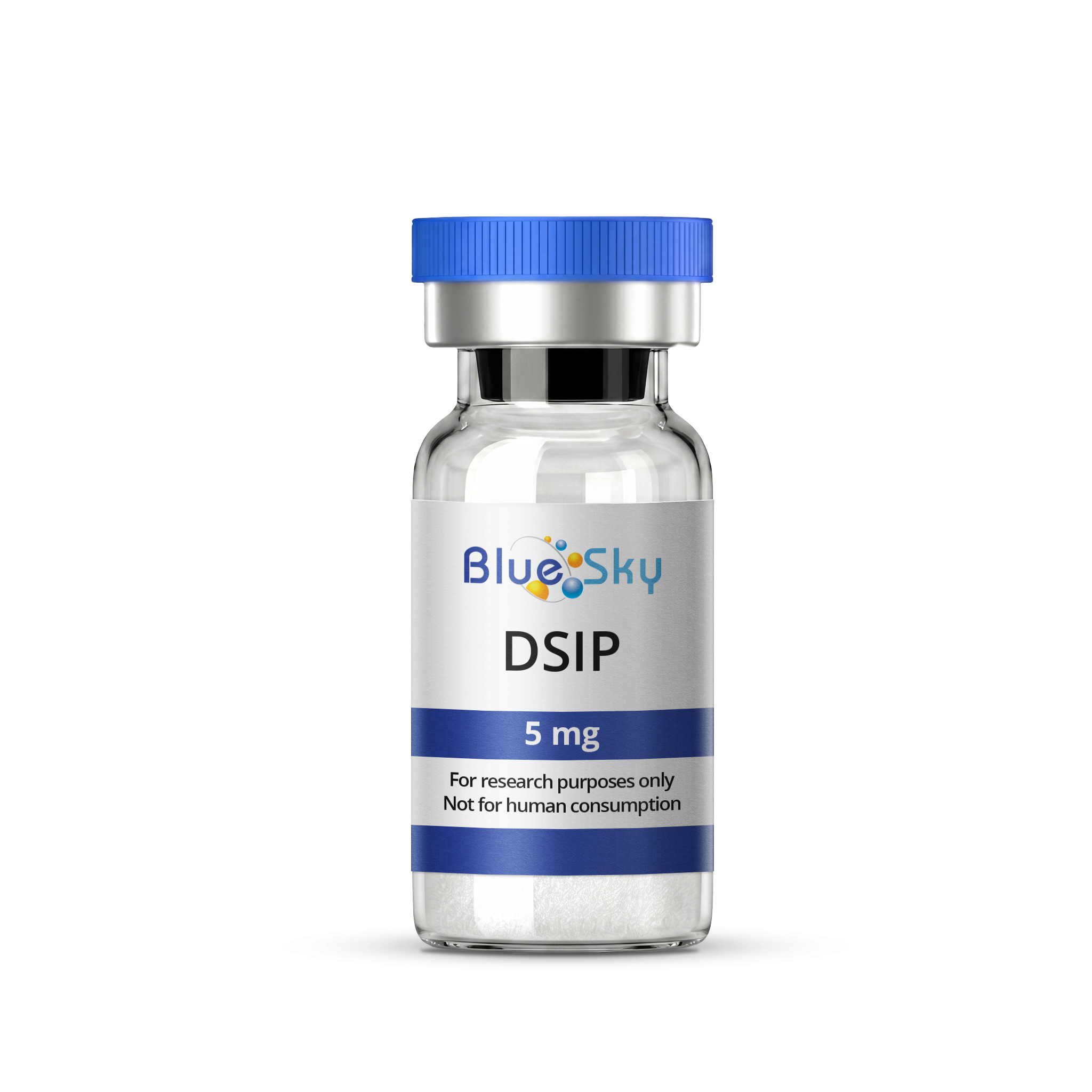
DSIP 5mg

- Free Priority Shipping
- Orders over $75



Buy DSIP 5mg :
| Unit Size | 5 mg/vial |
| Unit Quantity | 1 vial |
| Purity (Mass Spectrometry and UV) | 96.20% |
| Sequence | Trp-Ala-Gly-Gly-Asp-Ala-Ser-Gly-Glu |
| Molecular Formula | C35H48N10O15 |
| Appearance | Lyophilized White Powder |
| Source | Chemical Synthesis |
| Storage | Lyophilized DSIP is stable at room Temperature for 90 days, however it is best to store in a freezer below - 8c for any extended period of time. |
| Terms | The products we offer are intended for laboratory research use only. Please familiarize yourself with our terms of service prior to ordering. |
DSIP 5mg
View Research Overview
Delta Sleep-Inducing Peptide (DSIP) is a synthetic nonapeptide with the sequence Trp-Ala-Gly-Gly-Asp-Ala-Ser-Gly-Glu, studied in vitro for its structural and biochemical properties.
Peptide Structure and Analytical Detection
DSIP's nine-residue sequence is notable for a glycine-rich, largely uncharged backbone punctuated by two acidic residues, aspartate at position 5 and glutamate at the C-terminus, a composition that contributes to the peptide's solubility profile in aqueous research buffers.
The single tryptophan residue at the N-terminus provides a UV-active chromophore, which researchers rely on for spectroscopic detection and quantification during chromatographic purity work, distinguishing DSIP analytically from peptides lacking aromatic residues.
Peptide Stability Considerations
As a short, unmodified peptide with free N- and C-termini and no disulfide bonds or D-amino acid substitutions, DSIP lacks the structural features that confer enhanced stability in many other research peptides, making it comparatively more susceptible to enzymatic degradation in biological research systems.
This structural simplicity is also why DSIP is compatible with common laboratory solvents, including water and acetonitrile, supporting its use in HPLC calibration and other purity assessment work.
Analytical Purity Verification
Purity verification for DSIP typically combines mass spectrometry, which confirms the observed mass against the expected value for the C35H48N10O15 formula, with reversed-phase HPLC, where the tryptophan chromophore supports reliable UV-based detection during separation.
Because DSIP is a short, unmodified peptide, researchers reviewing a certificate of analysis are encouraged to confirm both parameters together, since either method alone may not fully distinguish the intact peptide from closely related truncation products.
Storage and Handling in the Laboratory Setting
Consistent with other short, unmodified research peptides, lyophilized DSIP is generally more stable in its freeze-dried state and is stored under sub-zero freezer conditions to preserve integrity between experimental sessions.
Given the photosensitivity associated with tryptophan-containing peptides, laboratories also limit the lyophilized powder's exposure to light during storage.
Research Use and Limitations
All research involving DSIP must remain strictly confined to controlled laboratory experimentation. DSIP is not intended for any use outside of controlled laboratory research settings, and no biological activity in humans is implied.
DSIP is provided solely for scientific investigation and must be handled according to standard laboratory safety protocols.
Important Notice
DSIP is intended exclusively for in vitro laboratory research use only. It is not for human consumption or use, and has not been evaluated for safety or efficacy in humans. These findings do not establish safety, efficacy, or suitability for any human application.


 Login
Login