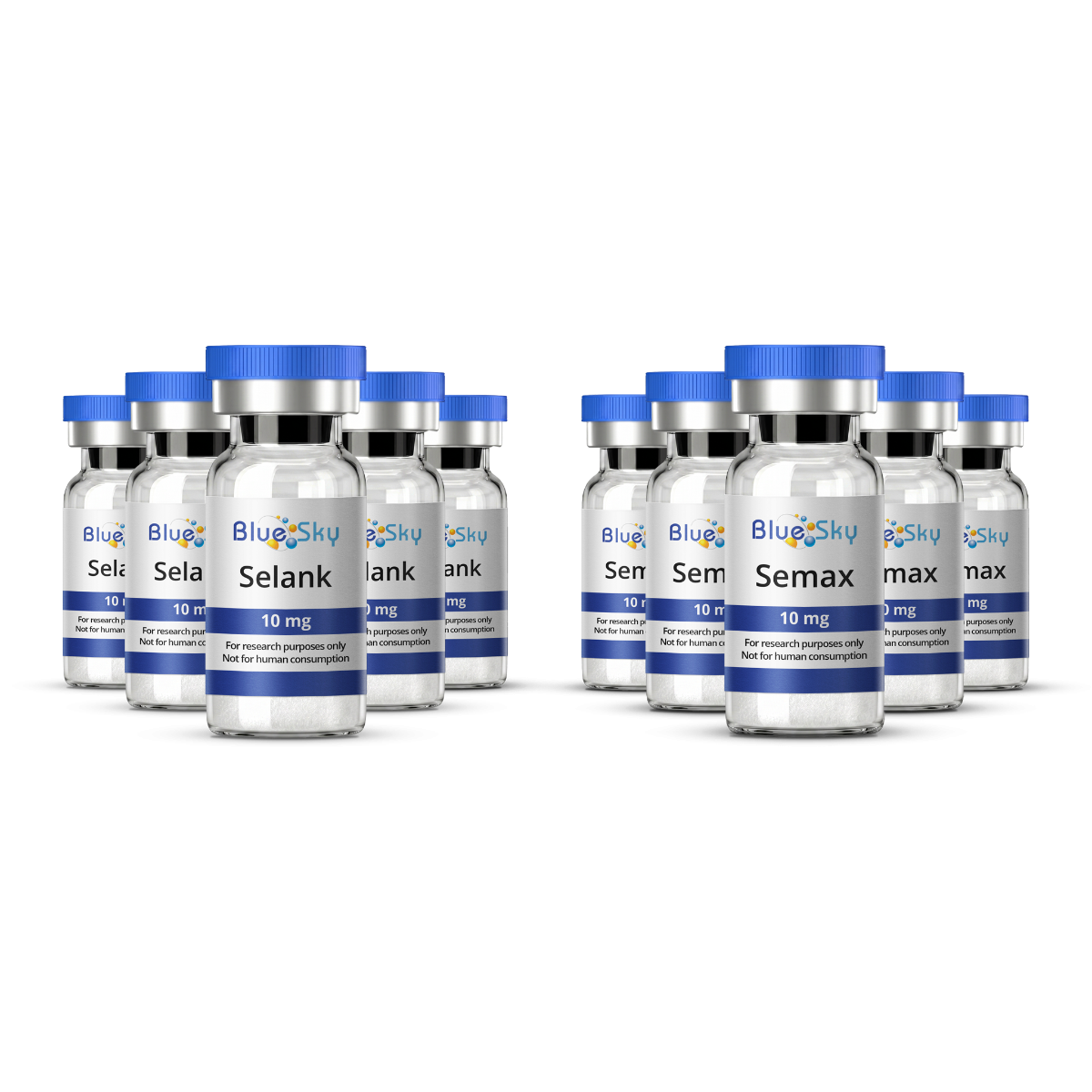
Bundle (Selank 10mg x5 + Semax 10mg x5)

- Free Priority Shipping
- Orders over $75



Selank 10mg :
| Unit Size | 10 mg/vial |
| Unit Quantity | 1 vial |
| Purity (Mass Spectrometry and UV) | 99.06% |
| Sequence | H-Thr-Lys-Pro-Arg-Pro-Gly-Pro-OH |
| Molecular Formula | C33H57N11O9 |
| Appearance | Lyophilized White Powder |
| Source | Chemical Synthesis |
| Storage | Lyophilized Selank is stable at room temperature for 90 days, however it is best to store in a freezer below -8°C for any extended period of time. After reconstitution, Selank should be refrigerated at temperatures not to exceed 35°F. |
| Terms | The products we offer are intended for laboratory research use only. Please familiarize yourself with our terms of service prior to ordering. |
Semax 10mg :
| Unit Size | 10 mg/vial |
| Unit Quantity | 1 vial |
| Purity (Mass Spectrometry and UV) | 99% |
| Sequence | H-Met-Glu-His-Phe-Pro-Gly-Pro-OH |
| Molecular Formula | C37H51N9O10S |
| Appearance | Lyophilized White Powder |
| Source | Chemical Synthesis |
| Storage | Lyophilized Semax is stable at room temperature for 90 days, however it is best to store in a freezer below -8°C for any extended period of time. After reconstitution, Semax should be refrigerated at temperatures not to exceed 35°F. |
| Terms | The products we offer are intended for laboratory research use only. Please familiarize yourself with our terms of service prior to ordering. |
Bundle (Selank 10mg x5 + Semax 10mg x5)
View Research Overview
This bundle pairs five 10mg vials of Selank with five 10mg vials of Semax. Both are synthetic heptapeptides derived from larger parent peptides, and both carry a C-terminal proline-glycine-proline (Pro-Gly-Pro) motif, which makes the pair a useful side-by-side study in peptide chemistry.
Despite that shared design feature, the two originate from completely different parent sequences, giving each its own charge, chemistry and analytical profile.
Shared Design, Different Origins
- Selank: Thr-Lys-Pro-Arg-Pro-Gly-Pro, about 752 g/mol. It is a synthetic analog of the naturally occurring peptide tuftsin (Thr-Lys-Pro-Arg), with the Pro-Gly-Pro motif appended.
- Semax: Met-Glu-His-Phe-Pro-Gly-Pro, about 814 g/mol. It is derived from the 4–10 fragment of adrenocorticotropic hormone (ACTH), a melanocortin-family peptide, likewise extended with Pro-Gly-Pro.
Both are built on the same principle: take a short bioactive parent sequence and append a glyproline fragment to improve its resistance to enzymatic breakdown. Studying them together isolates how that shared stabilizing motif behaves against two different peptide backbones.
The Pro-Gly-Pro Stabilizing Motif
Proline is the one standard amino acid whose side chain loops back onto its own backbone nitrogen, forming a ring that rigidifies the peptide bond and blocks many proteases that require a flexible, extended substrate.
In a Pro-Gly-Pro arrangement, two prolines flank a small, flexible glycine. This gives the C-terminus both conformational constraint and resistance to the exopeptidases that would otherwise trim a peptide from its C-terminal end.
Because Selank and Semax share this exact motif but differ everywhere else, the pair is a clean illustration of how a single stabilizing element carries across to peptides of very different composition.
Selank: Chemistry and Charge
Selank is strongly basic. It carries a lysine and an arginine, plus a free N-terminal amine, against no acidic residues, giving it a high net positive charge at neutral pH.
In practice this means excellent solubility in water and dilute acidic solutions. Like other highly basic peptides, it can adsorb to glass and some plastics at low concentration, so low-binding labware or a carrier protein helps preserve working concentration.
Selank contains no methionine, cysteine, tryptophan or tyrosine, so it has neither a notable oxidation liability nor meaningful UV absorbance at 280 nm. Its proline-rich composition makes it chemically robust overall.
Semax: Chemistry and the Melanocortin Connection
Semax is more chemically varied. Its N-terminal methionine is an oxidation site, converting to methionine sulfoxide (+16 Da) under air, light or trace metals, and its histidine can take part in metal-catalyzed oxidation.
Because its N-terminal segment comes from ACTH, Semax belongs chemically to the melanocortin ligand family, which binds class A GPCRs (MC1R–MC5R) that couple to Gαs and raise cyclic AMP. The conserved melanocortin recognition element is a His-Phe-Arg-Trp sequence; Semax retains the His-Phe portion but not the full motif.
Structural studies of this receptor family provide the reference framework for melanocortin-ligand work. A cryo-EM structure of the melanocortin-4 receptor (MC4R) bound to a peptide agonist and Gs has mapped the binding pocket [1], and an earlier MC4R structure identified a calcium ion bound jointly to the receptor and ligand, with extracellular Ca2+ markedly increasing agonist affinity [2].
Running Assays on the Pair
The two peptides are generally studied in separate systems, because their relevant targets differ:
- Semax: profiled against melanocortin receptors in receptor-expressing cell lines, usually by cAMP accumulation or competition binding, with
45% Off SITEWIDE
NO PROMO CODE REQUIRED


 Login
Login