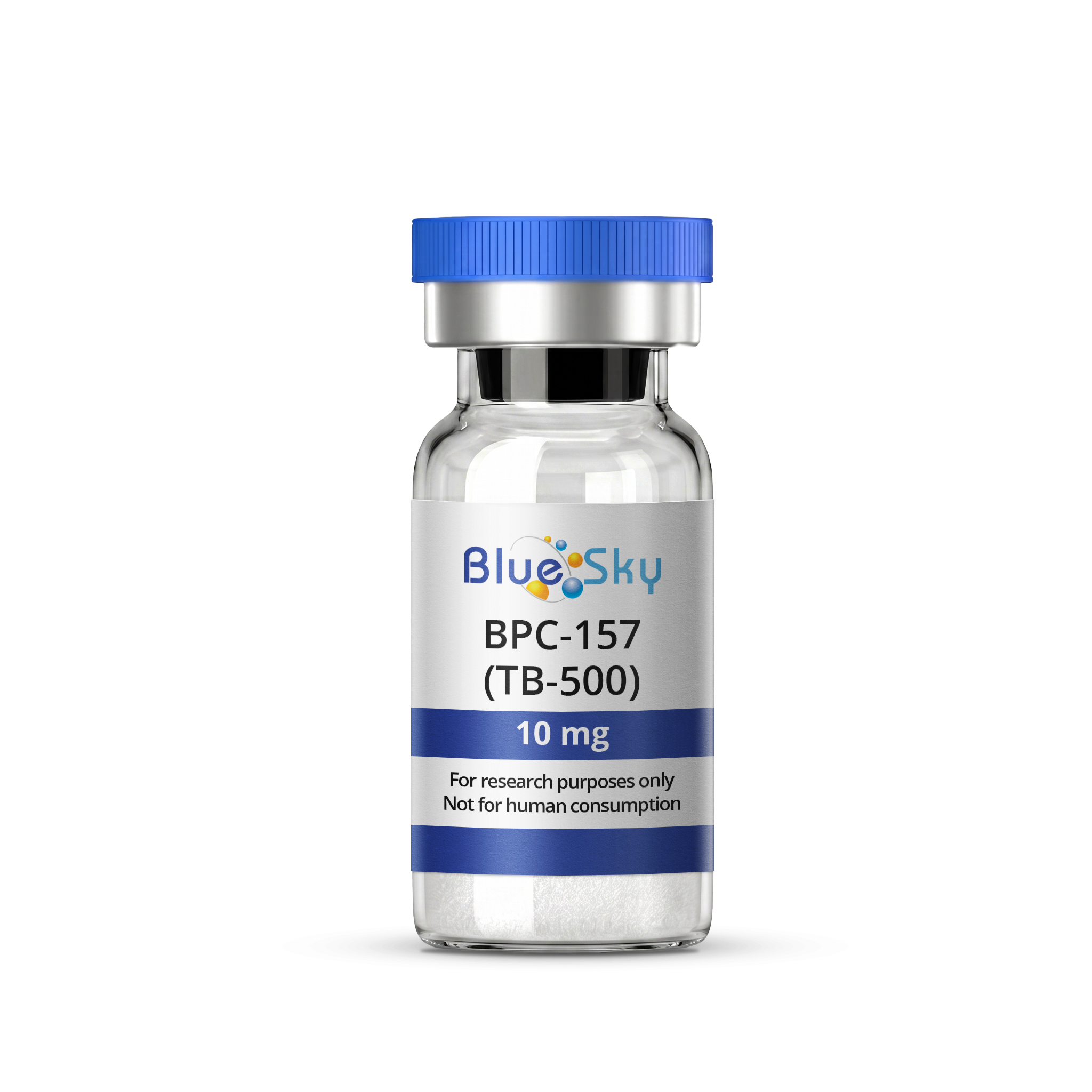
Blend BPC-157 5mg with Thymosin Beta 4 (TB500) 5mg

- Free Priority Shipping
- Orders over $75


Buy Blend BPC-157 5MG with Thymosin Beta 4 (TB500) 5MG:
| Unit Size | 10 mg/vial |
| Unit Quantity | 1 vial |
| Purity (Mass Spectrometry and UV) | 99.77% Nominal Target: 5 mg BPC-157 + 5 mg Thymosin Beta 4 (TB500) |
| Sequence (BPC-157) | H-Gly-Glu-Pro-Pro-Pro-Gly-Lys-Pro-Ala-Asp-Asp-Ala-Gly-Leu-Val-OH |
| Sequence (TB500) | Ac-Ser-Asp-Lys-Pro-Asp-Met-Ala-Glu-Ile-Glu-Lys-Phe-Asp-Lys-Ser-Lys-Leu-Lys-Lys-Thr-Glu-Thr-Gln-Glu-Lys-Asn-Pro-Leu-Pro-Ser-Lys-Glu-Thr-Ile-Glu-Gln-Glu-Lys- Gln-Ala-Gly-Glu-Ser-OH |
| Molecular Formula (BPC-157) | C62H98N16O22 |
| Molecular Formula (TB500) | C212H350N56O78S |
| Appearance | Lyophilized White Powder |
| Source | Chemical Synthesis |
| Storage | Lyophilized Blend BPC-157 5MG with Thymosin Beta 4 (TB500) 5MG is stable at roomTemperature for 90 days, however it is best to store in a freezer below - 8c for any extended period of time. . |
| Terms | The products we offer are intended for laboratory research use only. Please familiarize yourself with our terms of service prior to ordering. |
Blend BPC-157 5mg with Thymosin Beta 4 (TB500) 5mg
View Research Overview & References
This blend pairs BPC-157, a 15-residue pentadecapeptide, with the considerably larger 43-residue Thymosin Beta 4 (TB500), supplied together as a single lyophilized formulation for in vitro laboratory research.
Thymosin Beta 4 Actin-Sequestering Mechanism
Thymosin Beta 4 functions as the principal G-actin sequestering peptide in the cytoplasm, binding monomeric actin in a 1:1 complex that inhibits its polymerization into filaments, a mechanism central to laboratory research on cell motility and differentiation.1
Thymosin Beta 4 Tissue Distribution Research
Immunolocalization studies using human autoptic tissue samples spanning the tongue, oesophagus, stomach, ileum, colon, liver, and pancreas examined Thymosin Beta 4 distribution across fetal and adult human gastrointestinal tissue.
Distinct differences in reactivity between fetal and adult tissue were observed in several organs, contributing to basic research on this peptide's distribution across human development.2
BPC-157 Cell-Based Signaling Research
BPC-157's proline-rich, conformationally constrained backbone, roughly a quarter of its fifteen residues, is studied as a structural basis for its resistance to enzymatic degradation relative to less rigid peptides of similar length.
In vitro studies using cultured cell models found that BPC-157 promotes cell proliferation, migration, and angiogenesis-related signaling within this cell-based system.3
Combined Research Applications
Both peptides have established, separately studied laboratory profiles, actin-sequestering and tissue-distribution research for Thymosin Beta 4, proliferation and migration signaling for BPC-157, that are examined together in this formulation as a single research platform.
Combined use of the two peptides remains an area of exploratory laboratory research, and available data on concurrent use is preliminary and not considered conclusive.
Analytical Verification for Blended Products
Given the substantial size difference between a 15-residue and a 43-residue peptide, researchers reviewing documentation for this blend are encouraged to confirm that HPLC or mass spectrometry data resolves BPC-157 and TB-500 as distinct peaks rather than reporting a single aggregate purity figure.
Storage and Handling in the Laboratory Setting
TB-500's single methionine residue makes it more susceptible to oxidative degradation than BPC-157's proline-rich backbone, giving the two peptides different sensitivities within the same vial.
The lyophilized blend is stored under sub-zero freezer conditions to preserve both components' integrity prior to use.
Important Notice
This product is intended solely for in vitro laboratory research and is not suitable for human consumption, diagnostic use, or therapeutic application. All handling must comply with institutional laboratory safety protocols and applicable research regulations, and these findings do not establish safety or efficacy in humans.
Product Information
The material is supplied as a lyophilized white powder. Each vial contains a total of 10 mg of peptide content, consisting of 5 mg of BPC-157 and 5 mg of Thymosin Beta 4 (TB500), intended strictly for in vitro laboratory research.
References
1. Goldstein AL, Hannappel E, Sosne G, Kleinman HK. Thymosin β4: a multifunctional regenerative peptide. Expert Opin Biol Ther. 2012;12(1):37-51.
2. Nemolato S, Cabras T, Cau F, et al. Different Thymosin Beta 4 Immunoreactivity in Foetal and Adult Gastrointestinal Tract. PLoS One. 2010;5(2):e9111.
3. Huang T et al. Body protective compound-157 promotes proliferation, migration, and angiogenesis in vitro. Drug Des Devel Ther. 2015;9:2485-99.


 Login
Login