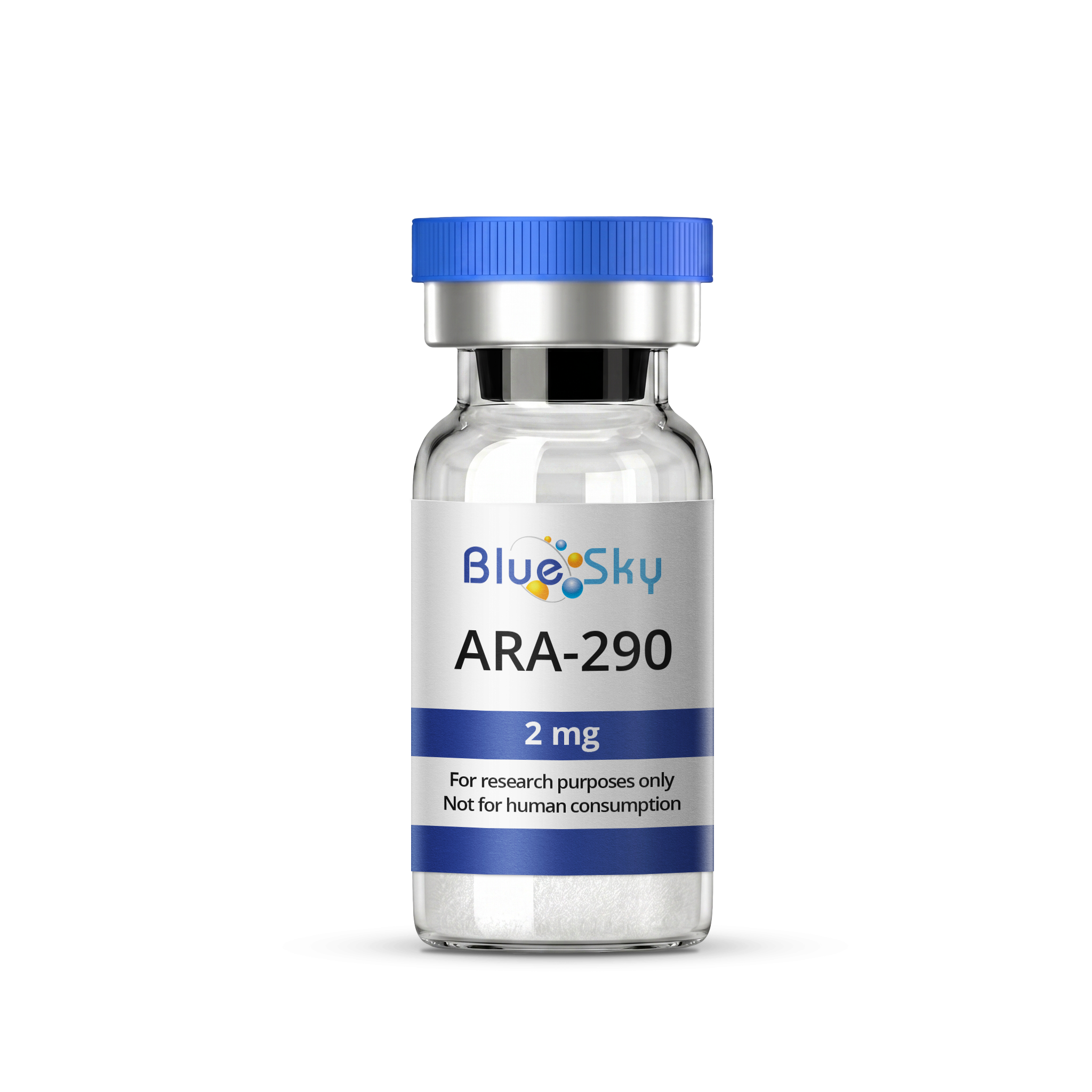
ARA-290 2mg

- Free Priority Shipping
- Orders over $75



ARA-290 2mg :
| Unit Size | 2 mg/vial |
| Unit Quantity | 1 vial |
| Purity (Mass Spectrometry and UV) | 99.20% |
| Sequence | ZEQLERALNSS |
| Molecular Formula | C51H84N16O21 |
| Appearance | Lyophilized White Powder |
| Source | Chemical Synthesis |
| Storage | Lyophilized ARA-290 is stable at room temperature for 90 days, however it is best to store in a freezer below -8°C for any extended period of time. |
| Terms | The products we offer are intended for laboratory research use only. Please familiarize yourself with our terms of service prior to ordering. |
ARA-290 2mg
View Research Overview & References
ARA-290 is a synthetic 11-amino acid peptide engineered from the helix-B surface domain of erythropoietin (EPO). It is studied in laboratory research for its interaction with the innate repair receptor (IRR), a heteromeric complex composed of the erythropoietin receptor (EPOR) and the beta-common receptor (CD131).
This receptor complex is distinct from the classical EPOR homodimer responsible for red blood cell production. This product is studied in vitro and is not intended for human use or consumption.
Receptor Binding and Mechanism Research
Laboratory research has characterized ARA-290's binding selectivity for the IRR over the classical erythropoietin receptor homodimer, a distinction established through in vitro receptor-binding and cell-based assays.1
Related work using P-19 cells, an established neuronal-like cell line, demonstrated colocalization of the erythropoietin receptor and the beta-common receptor through receptor coimmunoprecipitation, supporting the concept of a distinct heteroreceptor complex mediating tissue-protective signaling.2
In Vitro Neuroprotection Research
Laboratory research on the helix-B-derived peptide family, of which ARA-290 is a member, has reported neuroprotective activity in cultured cell models.1 This is a cell-based laboratory observation and does not establish safety, efficacy, or suitability for any human application.
In Vitro Cellular Research
In vitro studies using cultured urothelial cells have examined ARA-290's effects on innate immune signaling markers and cellular response to bacterial exposure.3
Peptide Structure and the Pyroglutamate N-Terminus
ARA-290's eleven-residue sequence begins with a pyroglutamate (pGlu) residue rather than a standard free amine, a cyclized N-terminal structure formed from glutamine or glutamic acid. Researchers studying short bioactive peptide fragments have noted that this modification is commonly used to protect the N-terminus from exopeptidase-mediated degradation, since aminopeptidases generally cannot act on a cyclized residue.
This structural feature is a relevant consideration when researchers compare the in vitro stability of ARA-290 to other short linear peptide fragments lacking N-terminal protection.
Analytical Purity Verification
Purity verification for ARA-290 typically combines HPLC and mass spectrometry to confirm both the correct 11-residue sequence and the presence of the cyclized pyroglutamate N-terminus, since incomplete cyclization during synthesis can yield a linear glutamine or glutamic acid variant with a different mass and altered stability profile.
Researchers reviewing a certificate of analysis for this compound are encouraged to confirm that analytical data specifically addresses N-terminal cyclization status rather than sequence mass alone.
Storage and Handling in the Laboratory Setting
Lyophilized ARA-290 is stored under sub-zero freezer conditions to preserve integrity between experimental sessions, consistent with standard handling practices for short synthetic research peptides used in receptor-binding and cell-based assay work.
Comparative Research Context Among Non-Erythropoietic EPO-Derived Peptides
ARA-290 is studied alongside other non-erythropoietic peptides engineered from the helix-B region of erythropoietin, sharing the design goal of isolating EPO's tissue-protective receptor signaling from its erythropoietic activity.
Researchers comparing these EPO-derived peptides have focused on how differences in sequence length and terminal modifications correspond to differences in IRR selectivity and in vitro stability, a comparative approach that continues to inform experimental design in cell-based EPO signaling research.
Important Notice
ARA-290 is intended for laboratory research use only (in vitro). This product is not intended for human use or consumption, has not been evaluated for safety or efficacy in humans, and is not approved by the FDA or any regulatory agency for any use.
These findings do not establish safety, efficacy, or suitability for any application outside of controlled in vitro laboratory research.
References
1. Brines M, Patel NS, Villa P, et al. Nonerythropoietic, tissue-protective peptides derived from the tertiary structure of erythropoietin. Proc Natl Acad Sci U S A. 2008;105(31):10925–10930.
2. Brines M, Grasso G, Fiordaliso F, et al. Erythropoietin mediates tissue protection through an erythropoietin and common beta-subunit heteroreceptor. Proc Natl Acad Sci U S A. 2004;101(41):14907–14912.
3. Polgárová K, Lüthje P, Cerami A, Brauner A. The erythropoietin analogue ARA 290 modulates the innate immune response and reduces Escherichia coli invasion into urothelial cells. FEMS Immunol Med Microbiol. 2011;62(2):190–196.


 Login
Login